Brand Identity Design: A Guide For Brand Leaders & Marketing Teams

Brand identity design goes far beyond a logo and color palette. It is the system that keeps every piece of content looking and feeling like it came from the same company.
Most enterprise brands already have strong visual identities. The hard part is not designing them. It is making them stick when 50 people across 5 departments are all creating content at the same time, under deadline pressure.
When that system breaks down, it signals disorganization to prospects, creates compliance risks in regulated industries, and forces your creative team into an endless cycle of corrections and rework.
This article covers what a scalable brand identity system looks like, how to build one, and how to keep it consistent as your organization grows.
Why is brand identity important?
When a company’s brand identity is consistent, people recognize it instantly. When it breaks down, it loses credibility faster than most realize.
For marketing leaders managing distributed teams, brand identity is an operational concern more than an aesthetic one. Here is why it matters at scale:
- It protects your reputation: An off-brand flyer from a regional office does not just look sloppy. It signals internal disorganization to prospects and clients. In regulated industries like insurance or financial services, it can also create compliance problems.
- It reduces rework: When your team has clear, accessible brand standards, they spend less time asking “is this the right logo?” and more time shipping work.
- It builds trust over time: Consistency compounds. Every time a prospect sees a cohesive piece of collateral whether it is a social post, a printed brochure, or a proposal, they build a mental model of your brand. Inconsistency forces them to relearn who you are.
- It enables growth: Consistent brand identity means your reputation moves with you. When you enter a new market, you are not starting from zero. People recognize you faster, trust you sooner, and engage more readily because every touchpoint they’ve seen has been on-brand.
3 examples of strong brand identity design
The companies below do not just have strong brand identities. They have built systems that keep their brand consistent across hundreds of content creators, multiple locations, and a wide range of content produced every day.
1. Purdue University
Purdue’s brand is built around a clear visual system; the Boilermaker Gold, a defined typographic hierarchy, and a photography style that emphasizes real people doing real work. What makes it strong is not the look itself, but how consistently it holds across 13 schools, 6 campuses, and 106,000 students.
Purdue’s Marketing and Communications team built a library of over 350 brand-compliant templates using Marq, so campus partners could create their own materials without going off-brand.
Because of the templates, campus partners exported approximately 40,000 documents while the central team moved on to national-level brand storytelling campaigns. That is a brand identity that scales.
2. Engel and Völkers Gestalt Group
Engel and Völkers is a luxury real estate brand with roots in Germany and a growing presence across 7 US states. Their brand identity hinges on a premium aesthetic; clean layouts, high-quality photography, and a tone that reflects the caliber of property they sell.
When Rick Rybarczyk joined as Director of Marketing, assets were being created in whatever tool each person happened to know. There were no systems, no processes, and no consistency. He described it as “the wild wild west.”
Rebuilding their brand identity meant standardizing templates across 50 offices while still giving advisors the flexibility to personalize their listings. This way advisors created on-brand content at their own time and pace.
3. Fidelity National Financial
When you have 80+ subsidiaries operating under a single parent brand, brand identity stops being a design problem and becomes a governance problem. Before Marq, Fidelity National Financial had no central system. Assets were stored across scattered hard drives, and sales executives created their own collateral because the official process was too slow.
The fix was not stricter guidelines. It was a centralized template library where every subsidiary works from the same approved assets, smart fields handle personalization automatically, and the correct version of the brand becomes the only version available.
Step-by-step framework to build a scalable brand identity
This framework is for companies that already have an established brand, with real equity and clear guidelines, and now need to scale it across more teams, channels, and locations without losing control.
1. Define core identity elements strategically
Start with the essentials: primary logo, logo variations, color palette, typography, and imagery style. Define what each element is and when to use it.
Most organizations stop here and treat guidelines as complete. But guidelines without clear decisions do not hold up in practice. You still need to answer specific cases: which logo to use in co-branded materials, how to handle conflicts with partner branding, and whether sub-brands follow the same typography as the core brand.
For multi-location or multi-brand organizations, make the rules explicit. Define what is fixed across all entities, what can be adapted locally, and who has final approval for each type of decision. Documenting this upfront prevents repeated debates and inconsistent execution across teams.
Finally, assign ownership. A clear decision-maker for brand standards is essential. Without it, responsibility becomes unclear, and brand inconsistency accelerates as teams make their own interpretations.
2. Convert identity into usable templates
Brand guidelines in a PDF do not help someone who needs to create a flyer by Friday. They will open Canva, work fast, and produce something that is partly on-brand and partly not. Scale that across hundreds of people and you get a consistency problem, not a skills problem.
Turn your brand into ready-to-use templates for the formats your teams create most often: flyers, social posts, email headers, pitch decks, brochures, and proposals.
Build these templates based on real usage. Different organizations need different sets of templates depending on what they produce regularly. For instance, a higher education institution like Purdue needs templates for event promotions, alumni outreach, department newsletters, athletics collateral, and career fairs.

Scale Brand Templates With Marq
Give teams ready-to-use templates that keep everyday content consistent without slowing them down.
3. Lock critical brand elements
A template that anyone can fully edit is not a brand template, it is just a file. Once people can change fonts, move logos, or tweak colors, consistency breaks.
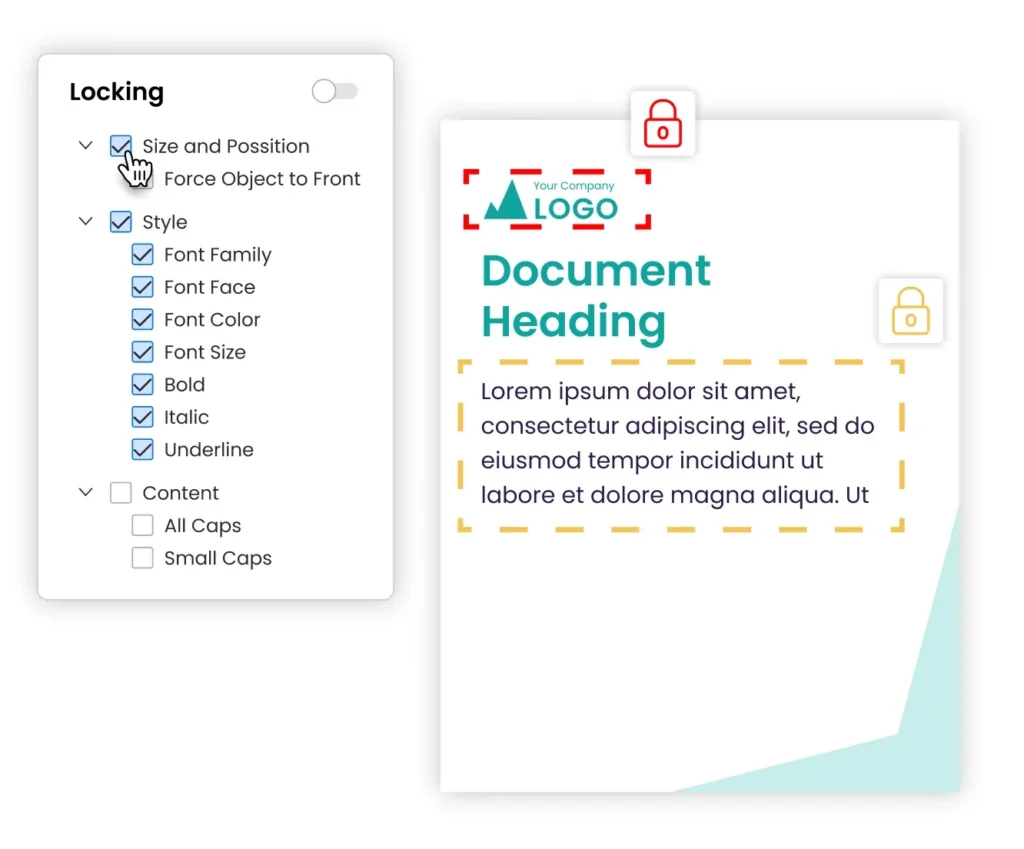
Lock the elements that define the brand: logo placement and size, color palette, typography, legal disclaimers, and any essential regulatory copy. Keep only the parts that should change, such as event details, names, locations, bios, and images.
Marq lets designers lock elements at different levels, from entire projects and pages down to individual images, text fields, and design components. Elements can be fully locked or partially controlled, such as fixing position, size, or style while keeping other properties editable.
4. Build workflows around identity users
Your designers are not the only people creating brand content. Sales teams build decks. Regional managers create event flyers. HR sends offer letters. Each group works differently and needs different levels of access.
Start by mapping who creates what before setting permissions. A financial advisor should not see the same controls as a senior brand manager. A department coordinator needs access to internal communications and event templates, not the full brand library.
When access matches real workflows, two things improve. People find what they need faster because their workspace is focused. And the risk of accidental edits to core brand assets drops significantly.
Marq supports this with Group Management. You can mirror your organizational structure using unlimited groups and subgroups, and share templates, folders, and projects at the group or subgroup level. This keeps each team working in a space tailored to their role without exposing everything to everyone.
Manage Brand Access With Marq
Give every team the right templates and permissions while keeping critical brand elements under control.
5. Measure and optimize identity usage
Brand compliance is not a one-time setup. You need visibility into how your brand system is being used in practice.
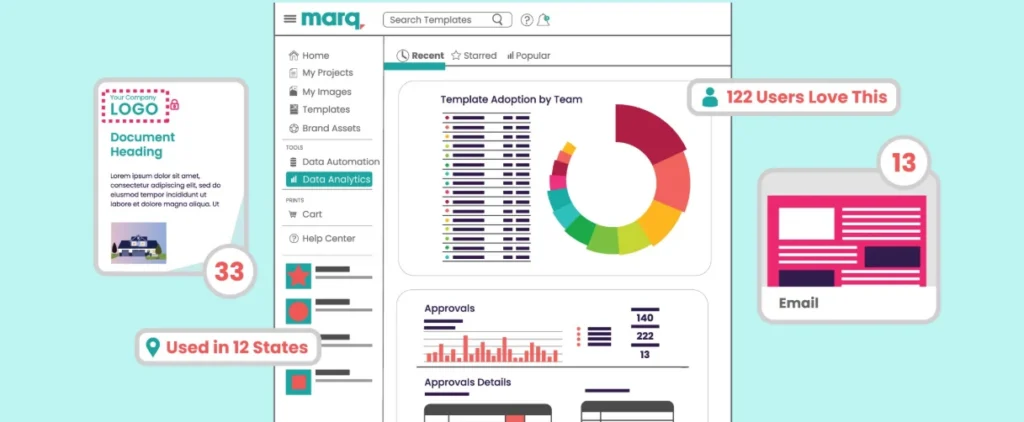
Track template usage across teams. If a template is not being used, it is either not aligned with real workflows or it is too hard to find. Track team-level adoption as well, because low usage usually means content is being created outside the system.
Use this data to make decisions: what templates to build, where access needs adjustment, and where workflows are breaking down. It also shows where brand rules are too rigid and slowing teams down.
Marq Analytics gives this visibility by showing which templates are used, how often they are used, and which teams are active or falling off.
3 best practices for scaling brand identity design
Building a brand identity system is the first step. The harder part is maintaining it when new teams join, new markets open, and content volume grows. These three practices keep it from falling apart.
1. Build brand identity as a living system
The brand identity system breaks down when it is treated like a campaign instead of something that needs ongoing maintenance. Most companies invest heavily in the launch, create the guidelines, then let the system drift as teams fall back into old habits and outdated assets start stacking up.
Set a fixed review cycle. Every six months, audit your template library, remove outdated assets, and check where brand rules are being broken. Decide whether the issue is enforcement or whether the brand standard itself needs to change.
Update the system whenever the business changes, such as new products, new regions, or acquisitions. If the system does not reflect reality, teams will stop using it.
2. Standardize approvals before content goes out the door
In most marketing teams, approvals happen informally. Someone finishes a piece of content, sends it over Slack or email, gets a quick thumbs up, and publishes it. That works at a small scale. At enterprise scale, it turns into a bottleneck. Managers end up reviewing hundreds of assets, things get missed, and off-brand content slips through.
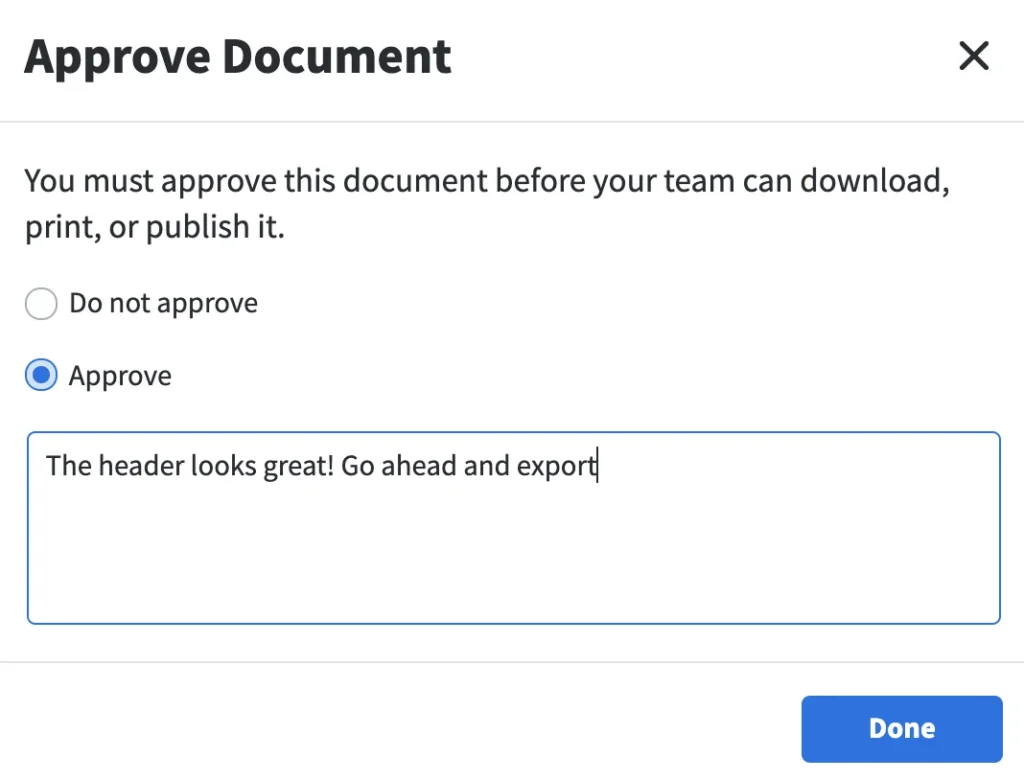
Build approvals directly into your template system. Once content is ready, it automatically moves into a review queue. The right stakeholder is notified, reviews it, and either approves it or sends it back with comments. Marq’s approval workflows support this by embedding review steps directly into the content creation process.
3. Update centrally, propagate automatically
Every time you push a brand update manually, someone misses it. Half the team sees the email, a quarter updates their files, and the rest keep using the old version for months.
The answer is a system where updates propagate automatically. Marq’s Smart Brand Assets make this possible.
When your team updates a logo, color palette, or any brand element in the content library, every template updates instantly. This way, distributed teams always work with current, approved collateral without waiting on an announcement.
A checklist for consistent brand execution
Use this checklist to audit your current brand system and identify gaps before they become problems.
Ensuring brand consistency with Marq
Marq is a brand enablement platform for mid-market and enterprise teams managing distributed content creation. It connects brand teams and content creators by giving designers control over what can and cannot be changed, while enabling everyone else to quickly create on-brand materials.
Key features
- Template locking and permissions: Lock fonts, logos, colors, and layouts at the template level. Define editable sections for each user group, so people can only change what they are supposed to and nothing else.
- Smart fields: Auto-populate templates with names, addresses, contact information, pricing, and more from a spreadsheet or a Customer Relationship Management (CRM) system.
- Approval workflow: Marq lets teams review content before it goes live by routing assets to the right stakeholders for feedback directly within the template system.
- Global brand updates: Update a brand element once and it propagates across every template and every user instantly.
- DAM integrations: Marq connects natively with enterprise Digital Asset Management (DAM) platforms including Bynder and MediaValet. Content creators pull approved, up-to-date assets directly into templates without leaving the platform.
What customers say
Andrea Mattingly from Purdue University shares, “It’s just been totally transformative. Marq has not only allowed us to produce better quality pieces, but also a higher quantity of pieces
because it’s just so easy and convenient to use.”
Rick Rybarczyk from Engel & Völkers Gestalt Group says, “When I looked into Marq with our needs in mind, I saw that the platform itself and the use of templates is designed to provide consistency. Consistency, along with speed and accuracy are the cornerstones of good
marketing, and they’re all built right into Marq’s tool.”
Maintain and scale consistent brand identity with Marq
Brand identity design is not a one-time deliverable. It is a system that needs to hold up when your team doubles, when you open a new office, or when a regional manager decides to make their own flyer at 9pm before an event.
Marq gives brand and marketing teams the infrastructure to make consistency the default, instead of something that needs constant oversight.
If your brand is ready to scale, book a demo to see how Marq works for distributed teams.
FAQ’s
Brand identity design is the process of creating a consistent visual and communication system for a company. It covers a company’s logo, colors, typography, imagery, and tone of voice, and ensures every piece of content feels on-brand and easy to recognize.
Branding is the overall strategy that defines how a company wants to be seen and remembered. Brand identity design is how that strategy is translated into the actual elements people see and interact with, like logo, colors, imagery, and tone of voice.
Maintain brand identity at scale by centralizing asset storage, converting your guidelines into locked templates, and setting role-based access so each team can create content within approved guardrails.
Most established companies refresh their brand identity every 5-10 years, or whenever there is a major shift in strategy such as a merger, new market entrance, or a repositioning. A brand refresh is not a full reset, it usually means updating certain elements to stay current while keeping the parts people recognize the same.