Self-service marketing: How to scale content without losing brand consistency

Most marketing teams that struggle to scale content for complex orgs eventually land on the same answer: give distributed teams the tools to create their own materials. Stop routing everything through a central designer. Let sales reps, regional teams, and location managers self-serve.
That part works. Self-service solves the bottleneck.
The problem is that giving teams more access to assets or creation doesn’t protect the brand. Templates get modified. Compliance language gets dropped. Someone in a regional office decides the logo looked better in a different color. By the time it surfaces, the off-brand version has already been in front of clients.
Enabling self-service is now a necessity. The challenge is building a self-service system so that access/speed and control aren’t in conflict. This piece covers the frameworks that do both.
Why self-service marketing becomes difficult at scale
The goal of self-service is straightforward: distribute marketing work to the teams that need it so nothing waits on the central design team. Sales reps, regional teams, and agents get the technical capability to create their own materials without an intermediary.
The reason it breaks is that the platform most companies reach for falls short in one of two ways:
- It doesn’t give the teams you’re trying to enable easy access: If reps, regional managers, or agents can’t quickly find and use what they need, they bypass the system and go back to whatever’s fastest; an old file, a personal Canva account, etc.
- It gives access but doesn’t protect brand and compliance: The moment non-designers can edit freely with no guardrails, the output ships fast but off-brand: modified templates, missed disclaimers, wrong font type, etc.
A self-service platform has to solve both at once or else it breaks. Make access easy but weaken governance and you scale inconsistent content. Tighten governance but make access difficult and usage drops.
Either gap can exist at any company stage, but scale is what turns small issues into real damage.
With a handful of users, someone catches a workaround or an off-brand content and fixes it timely. As more teams come in and assets spread across markets, no one can review everything manually. Workarounds spread faster than people notice, and off-brand versions reach customers before anyone spots them.
Self-service marketing that breaks vs. self-service brand enablement
The problem is almost never self-service itself. It’s self-service without guardrails. Most companies sit somewhere on the spectrum below.
| Approach | How It Works | Outcomes |
| Ungoverned self-service | Teams can create anything based on the files they find. | Brand integrity and consistency falls as soon as volume scales or deadlines hit. |
| Fully centralized | Every asset routes through a central creative team. | Marketing becomes a service desk. |
| Self-service brand enablement | Locked templates, editable zones, and role-based access let distributed teams self-create within guardrails. | Non-designers self-serve at full speed and every asset stays on-brand because governance is built into the creation process. |
Self-service brand enablement lets teams move fast while keeping the brand in control. It makes self-service dependable at scale.
Marq supports this workflow. It lets non-designers create, update, and publish content using approved templates with built-in guardrails. For larger teams, it connects to existing brand assets through Digital Asset Management (DAM) integrations so approved visuals and live data flow directly into templates.
This setup helps teams produce consistent content across distributed groups without manual review at every step.
“Marq introduced the concept of self-serve design requests to our business. For the very first time, not everything has to go through our design team,” as shared by Bill McCandless, Global Head of Content Marketing and Operations, Kyndryl
5 frameworks to enable self-service marketing without losing control
These five frameworks cover the infrastructure decisions that separate a self-service system that scales from one that creates more problems than it solves.
1. Convert design files into governed, editable templates
Turn your existing design files into templates that non-designers can use. This is the foundation of the entire self-service system.
In Marq, designers define which elements are locked (logo, brand colors, legal disclaimers, font choices) and which zones are editable (name, phone number, location-specific details, event date). Once the template is ready, they publish it directly to the relevant team or portal. The team sees only the templates they are permitted to use and edit.
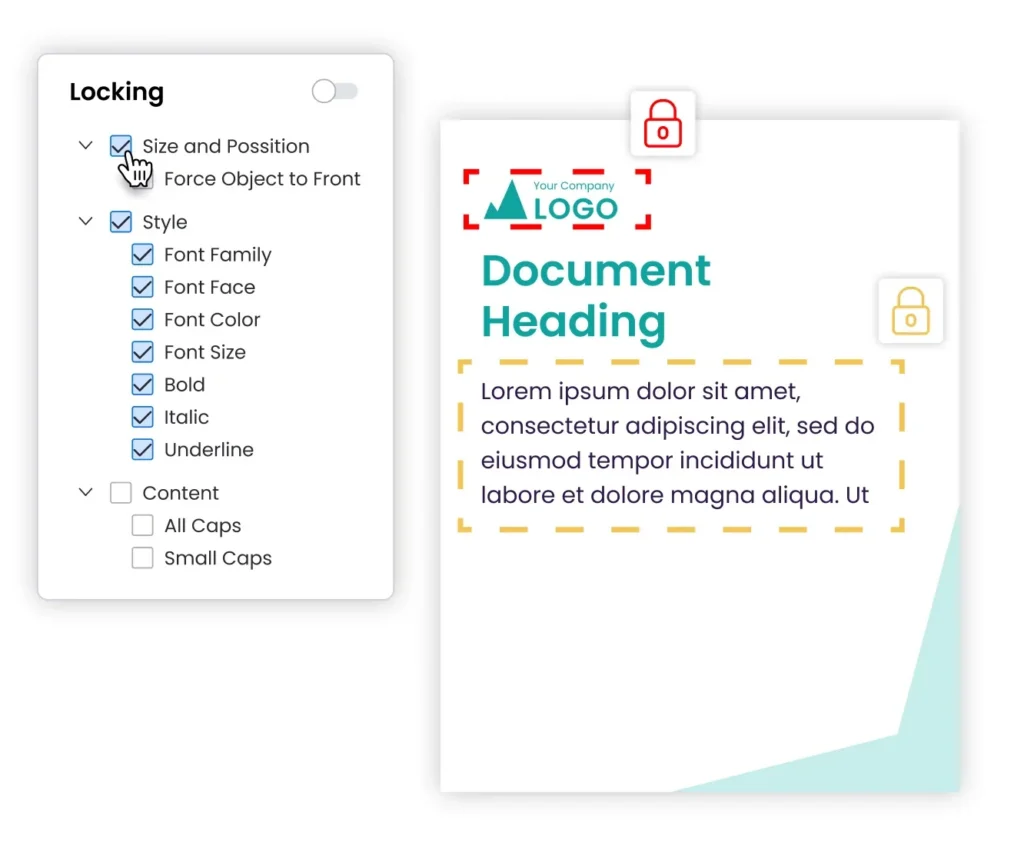
The best place to start with is your five most-requested content types. Build governed templates for those first, monitor feedback and usage, and expand the library from there.
Governed templates work because designers control the structure and keep quality consistent while distributed teams self-create without waiting for approvals.
2. Assign role-based access and publishing permissions
Not every person in your company should have access to every template. And not every template should be editable by everyone who can access it.
Marq organizes users into groups that mirror how the company works, and sets permissions at the group, user, and template level. In a real estate company, that might mean separate groups for the corporate marketing team, regional managers, field sales representatives, and external partners.
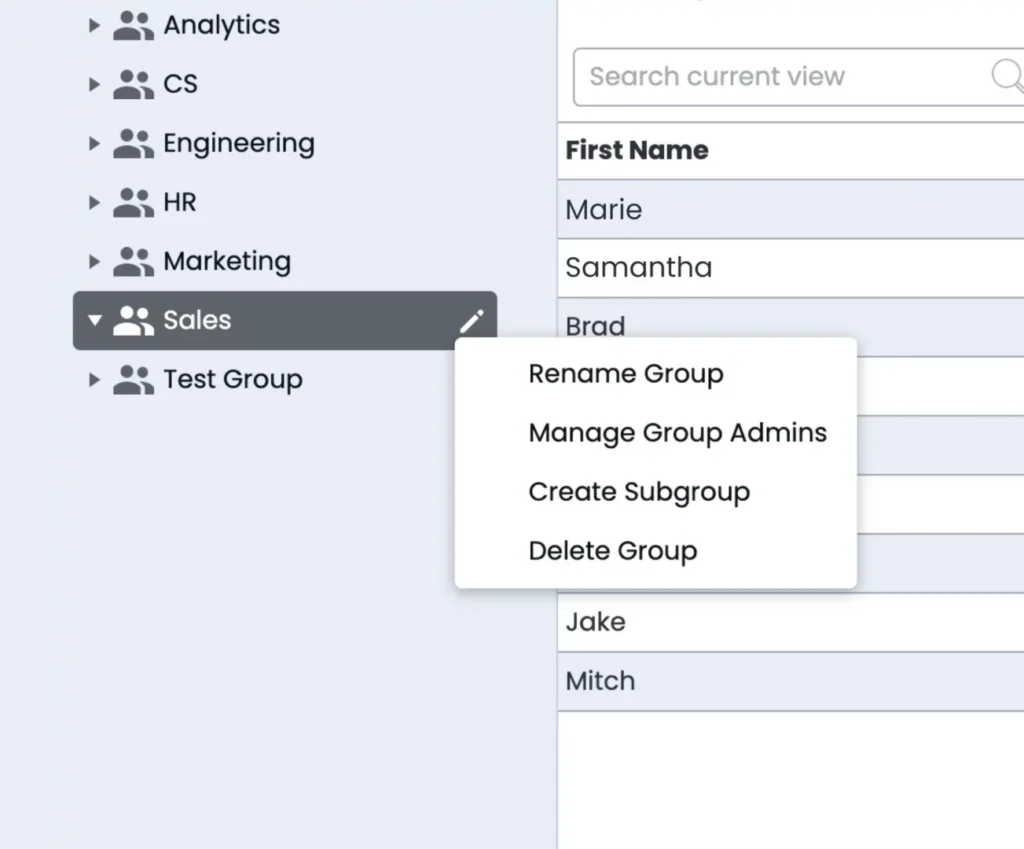
Administrators define what each group can see, edit, and publish. For example, sales representatives only access templates for their market and can edit only the allowed fields.
When a new team member joins, they’re added to the right group and immediately get the correct permissions, templates, and publishing rules.
3. Build self-service portals for each team or location
A single template library does not work for companies with multiple business units, departments, or geographic markets. Each team needs a workspace that reflects their specific brand, templates, and content needs.
Brand portals in Marq give each group their own curated workspace pre-loaded with the templates and assets relevant to them. A hospital network can give each clinic its own portal with location-specific templates. A financial services firm can give each regional office access to compliant collateral approved for their market.
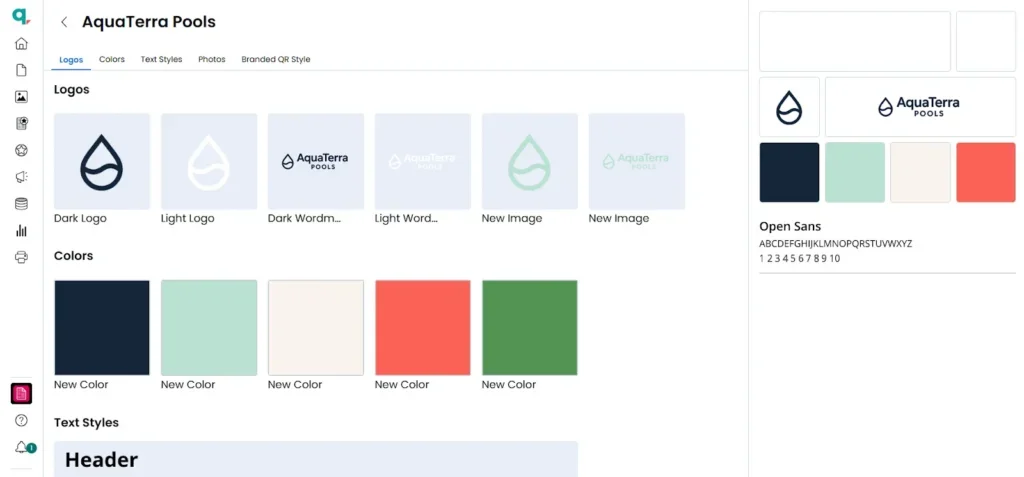
This matters for self-service because it removes the decision-making step. The team member does not choose from 200 templates. They open their portal, pick the template they need, fill in their editable fields, and publish.
4. Connect templates to live data sources
Static templates still require someone to manually update fields every time a new content piece is needed. At scale, this step does not just slow production down, it introduces errors: wrong disclaimers, outdated pricing, incorrect contact details that nobody catches until content is already in the market.
Marq’s Smart Fields connect templates directly to live data sources: spreadsheets, Customer Relationship Management (CRM) systems, and databases.
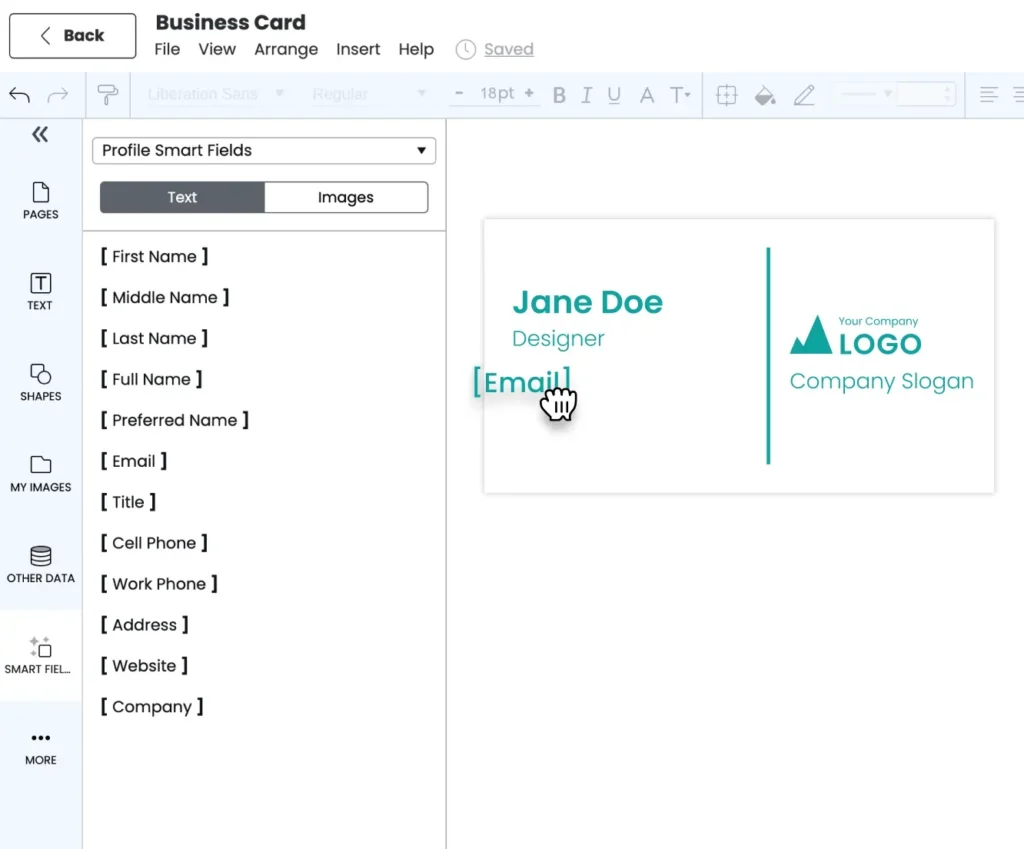
In higher education, this becomes especially powerful. A university running open day campaigns across multiple departments can generate a separate flyer for each one without a designer opening a single file. Details like department name, event date, and location pull directly from a spreadsheet.
The operational outcome is that distributed teams stop waiting on someone to update a file before they can use it. The template stays current by default. They open it, review the editable fields, and publish.
5. Build approval workflows for regulated industries
In financial services, insurance, healthcare, and other regulated industries, self-service does not mean unsupervised. A rate sheet with the wrong disclaimer or a campaign missing a required disclosure can create compliance exposure that can be costly for any company.
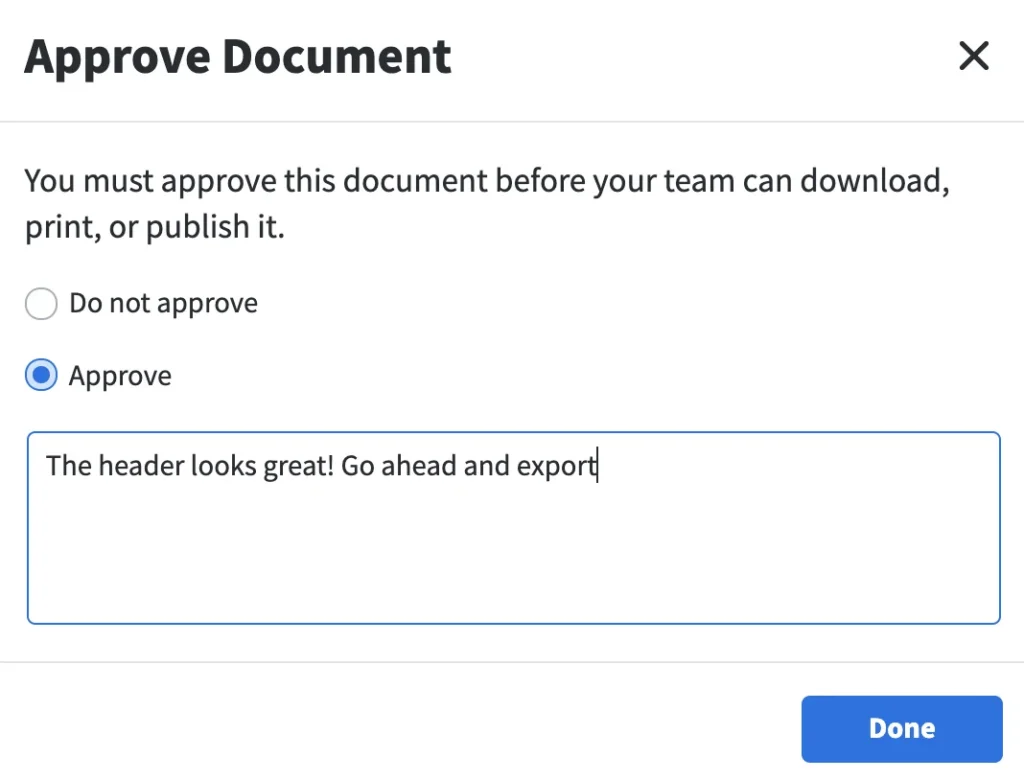
In Marq, admins set up an approval process that requires users to request sign-off before they can download, print, or publish any content.
A team member finishes their edits and clicks “Request Approval.” They choose the approver, add a note if needed, and submit. The approver gets notified, reviews the asset directly in Marq, and either approves it or sends it back with comments. The project shows a clear status throughout: pending, approved, or declined.
Case studies: How large teams execute self-service marketing at scale
The below companies operate in different industries and at different scales. What they have in common is a distributed content problem that self-serve brand enablement solved.
1. Johns Hopkins University
Overview: Johns Hopkins University runs nine schools across four campuses, with a creative strategy team of four serving thousands of staff members. During heavy workload periods, content wait times reached 3-4 weeks. Staff who needed content sooner created materials on their own, without access to the correct brand fonts or colors.
Solution implemented with Marq: The creative strategy team built a library of department-specific template collections in Marq. Smart Fields pre-loaded the correct logo for each of the nine schools automatically, preventing version confusion that had previously been an issue.
Results: Content wait time dropped from 3-4 weeks to one day. Designers moved off repetitive edits and onto strategic design work.
Abby Jackson, Director of Creative Strategy, described the shift: “Because of Marq, we’re able to maximize the design resources we have. Our designers can focus on setting up the initial templates for others to use, and then get on with the design work they are truly skilled to do.”
Key takeaway for marketing leaders: A creative team of four cannot serve thousands of staff members without a governed self-service system. This problem is solved through better infrastructure, not adding more team members.
2. Fidelity National Financial
Overview: Fidelity National Financial manages 23,000 employees across 80+ subsidiaries, each competing for business while sharing a parent brand. Before Marq, assets were scattered across hard drives throughout the company. Personalizing collateral for 2,000 sales executives was difficult. On top of that, regional marketing teams operated in silos with no shared workflow.
Solution implemented with Marq: Fidelity replaced the fragmented hard-drive system with one central template repository in Marq. Apart from this, Smart Fields automated personalization for the entire sales force: each rep’s photo and contact information populated automatically without manual entry.
Results: 800+ registered users across 29 subsidiaries now use Marq.
Matt Sweet, Product Marketing Manager, described the business impact: “From a management perspective, Marq creates efficiencies through cost-reductions. From a sales manager’s perspective, it allows their sales people to focus on prospecting and building relationships and not spinning their wheels on being a designer.”
Key takeaway for marketing leaders: Personalization at scale is only possible when data population is automated.
What to track and monitor for success
Here are the metrics that tell you whether self-service marketing is working on the right track.
Metrics that measure success
- Template adoption rate: What percentage of distributed content is being created through approved templates?
- Time to publish: How long does it take a team member to go from opening a brief to finished asset?
- Designer capacity freed: How many hours per week has the design team reclaimed from one-off requests?
- Content output volume: How much more content are distributed teams producing compared to before?
- Approval cycle time: How long does it take for assets to clear the review stage?
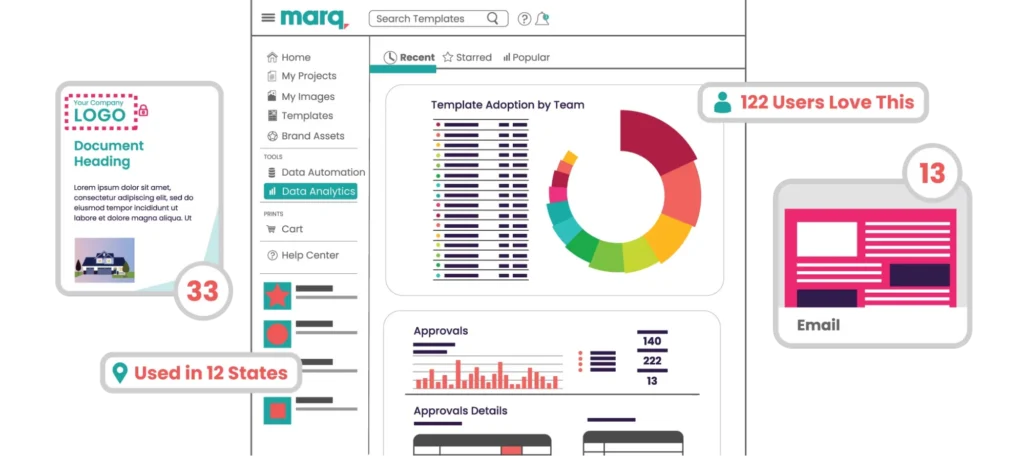
Marq’s Analytics shows template usage data, projects created from personal templates, and least engaged user groups, and more. This helps marketing leaders identify where adoption is strong and where teams are going off track, so they can fix issues before inconsistent content spreads.
Signs the current setup is breaking
- Design requests to the central team are not going down, even with self-service in place.
- Teams report that approved templates do not cover their use cases.
- Off-brand assets keep appearing in the market.
- Compliance flags are increasing quarter over quarter.
- Content created outside the platform is being used to fill gaps in the template library.
- Approval turnaround is so slow that teams publish without waiting for sign-off.
- Usage is mostly driven by one or two teams, while the rest of the organization barely uses the platform.
Best practices for scaling self-service marketing
Scaling self-service marketing requires discipline at the infrastructure level. These practices separate systems that scale from those that slowly break down.
Integrate with the tools your teams already use
Self-service only works when the approved platform is the easiest path available. When teams have to leave their existing tools to access assets or customer data, they bypass the approved system and use whatever is fastest.
Marq connects directly to the tools distributed teams already work in, including CRM platforms and DAM systems. It allows teams to pull customer data into templates and access approved brand assets without switching between tools.
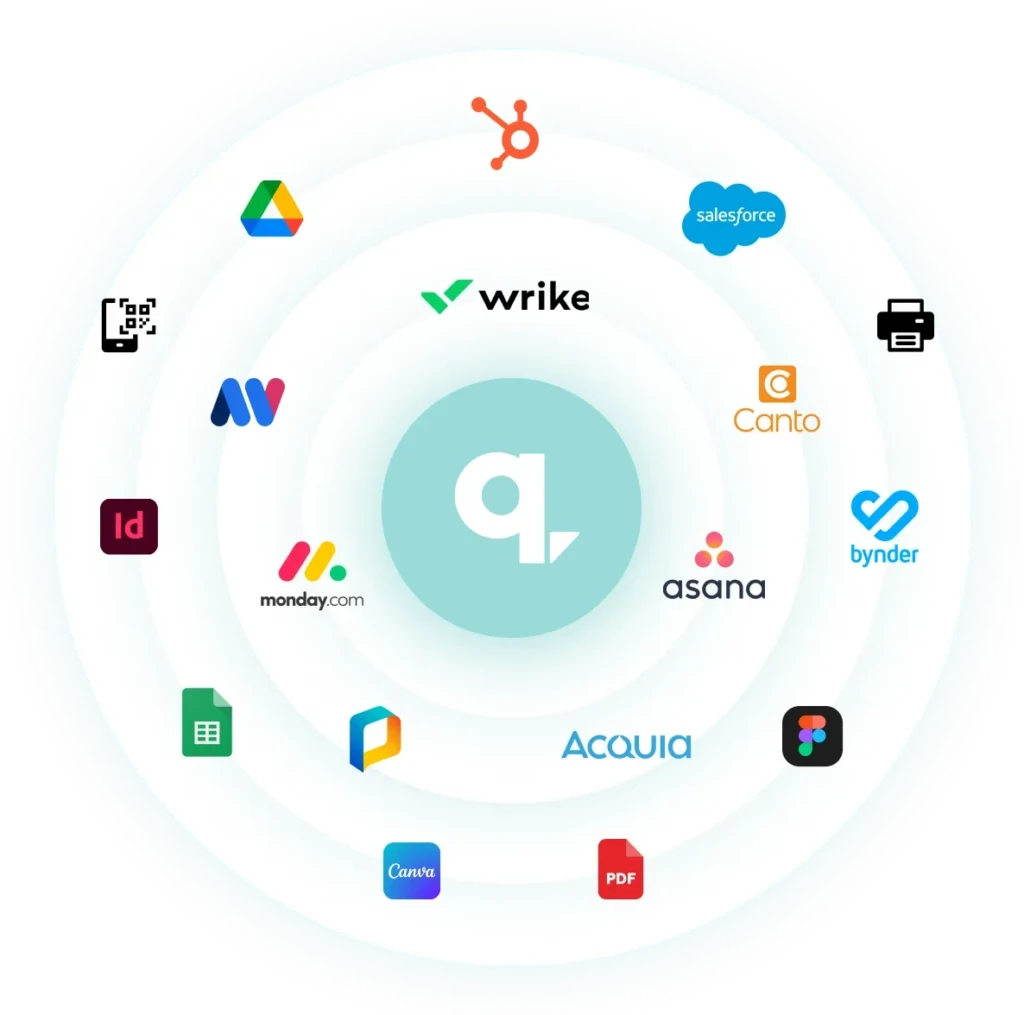
The same is true on the design side. Designers keep working in Adobe InDesign and turn those files into locked Marq templates. At @properties | Christie’s International Real Estate, that approach greatly sped up template creation:
“One of the things I love most about Marq is being able to upload InDesign files quickly on our own. Instead of waiting weeks to have templates created with other vendors, we can simply take an InDesign file, upload it into Marq, lock certain branding elements down, and have the template ready for agents and affiliates to use within a few minutes,” shares Natasha Patla, CMO, @properties | Christie’s International Real Estate.
Run a quarterly template audit
Self-serve marketing only works when the templates supporting it stay clean and up to date. As more teams create content, templates multiply, and the risk of teams using outdated versions grows. Over time, it becomes harder to know what is still approved.
A quarterly template audit keeps the system reliable. Assign a project admin to run it end-to-end. The admin should review active templates for accuracy, retire outdated versions, update brand elements, and ensure everything still reflects current guidelines.
They should also use platform analytics to identify underused templates and gaps by speaking with other team members about what’s missing or hard to find. This helps the system evolve based on real usage.
Marq improves this process by automatically pushing updates across all connected templates. When core elements like logos are updated in one place, the changes reflect everywhere they’re used, ensuring teams always work with the latest approved versions without manual updates.
Train users before you launch
Self-service marketing only works when people are shown how to complete real tasks inside the system before they start using it at scale. Without that, they fall back on familiar tools or build their own workarounds.
Training should be the responsibility of the people who understand both the system and the day-to-day workflows, usually a mix of marketing ops and brand/project admins.
Keep the training practical and task-based:
- Walk users through 2-3 real use cases, like creating a campaign banner, sales one-pager, social post, etc.
- Show one template in detail and point out what’s fixed (logo, layout, fonts) and what’s editable (copy, dates, images).
- Run a live example of the approval flow so users see exactly how an asset moves from draft to review to publish.
- Run a pilot with one team first and observe where users slow down or drop off. Use those friction points to adjust templates or instructions before full rollout.
Purdue University’s marketing team rolled it out exactly this way. They named a senior graphic designer, Cheryl Glotzbach, as the Marq lead. She built a set of templates for a small group of campus partners to test and ran a training session to get them comfortable with the platform. Once that pilot worked, Marq went out to campus partners university-wide. Cheryl Glotzbach says:
“Before Marq, there were many who wanted to create things on brand, but didn’t feel equipped to do so, because not everyone had access to the Adobe suite. As a result, we had a lot of staff turning to Word or Canva and creating materials that were off-brand.
Now that we have a tool like Marq that’s provided by the university to anyone who wants to use it, it sends the message that we’re all in this together, and that they really want to help us tell the Purdue story we’re trying to tell in the best possible way.”
Scale self-service marketing without losing control with Marq
Marq gives marketing leaders the infrastructure to build a self-service system: governed templates, role-based access, brand portals, creative automation, and a full integration ecosystem that connects to the tools your teams already use.
Book a demo to see how it works for your organization.
FAQs
What is self-service marketing?
Self-service marketing is a model where distributed teams (sales reps, agents, brokers, loan officers, partners, and GTM teams) create and publish marketing content independently, without routing every request through a central design team.
How do you prevent brand drift in a self-service marketing system?
Prevent brand drift by building governance into the creation process. Use approved templates with locked brand elements, role-based permissions, centralized asset libraries, and clear approval workflows. Regular template audits, user training, and usage monitoring help ensure teams create content independently while staying aligned with current brand standards.
How do you measure the ROI of a self-service marketing system?
Measure ROI across three dimensions: operational efficiency (reduction in design request volume and time-to-publish), brand integrity (decrease in off-brand asset incidents and compliance flags), and output volume (total assets created, documents exported, and campaigns launched by distributed teams).