Distributed Marketing Platform in 2026: What It Is, Benefits & More

95% of companies have brand guidelines, but only 25% enforce them. And the gap only gets worse when your teams are distributed.
Each new office, franchise, or partner team you add is another point where brand consistency can break down.
A distributed marketing platform gives your brand team and local offices a single place to work from. It becomes the layer between central brand ops and every local team that needs to create its own content. So headquarters retains control over templates, assets, and approvals, while field teams have a self-serve way to create and publish materials.
This guide covers the benefits for marketing leaders running distributed teams, what a modern distributed marketing platform needs to address, and a practical framework for scaling content production without losing brand control.
Top benefits of using distributed marketing software for marketing leaders
Distributed marketing software gives marketing leaders both control and speed. Here’s what that looks like in practice:
- Brand consistency across every location: With a distributed marketing platform in place, every asset that goes out the door looks and sounds like your brand. The central team sets the standards once, and local teams work from those pre-approved materials, regardless of which office, franchise, or partner is creating the content.
- Faster content production: Now that regional teams have direct access to ready-to-use templates and assets, they don’t need to sit and wait on central marketing for every flyer, one-pager, or social post. They create what they need on their own, when they need it. Production timelines that once stretched over days now shrink to minutes, and your central team stays focused on higher-impact work.
- Localized content that resonates: Your brand can run the same campaign across states, provinces, or countries, but the most impactful version is usually the one tailored to a local audience. With distributed marketing software, local teams can adapt messaging, imagery, and offers for their specific market, so content always feels relevant.
- Reduced compliance risk: Some industries, like healthcare, finance, and insurance, are more heavily regulated than others. A single non-compliant asset can create real regulatory exposure. With content created within controlled guardrails and state-level compliance requirements, teams can ensure regulatory consistency and reduce risk even further.
- Full visibility into content activity: Marketing leaders can track which assets teams are using, by whom, and where. This makes it possible to spot what’s working, retire what’s not, and make resourcing decisions based on usage rather than assumptions.
What a modern distributed marketing platform must solve
Not every platform that calls itself distributed marketing software actually solves the problems marketing leaders face daily. Here’s what to look for.
1. Centralized asset control
When assets are scattered across shared drives, email or Slack threads, and local desktops, it’s inevitable for an outdated logo, headshot, or campaign file to sneak into the final product. And even when teams do find the correct version, it can take hours to track it down.
A distributed marketing platform with centralized content management keeps every approved asset in one place, so local teams always pull from the most current version.
2. Template-based local customization
Giving regional teams a blank canvas is a recipe for disaster, no matter how talented they are. Things go off-brand quickly, and by the time someone catches it, the content is already out the door. Plus, those teams need to move fast. They don’t have time for rounds of back-and-forth with central marketing.
One of the simplest fixes for this is locked templates with editable zones. The brand team controls layout, colors, fonts, and logos. Regional teams only customize the fields they’re supposed to, like addresses, locations, offers, or headshots.
Marq’s brand templating is built around this exact model. It gives local teams the freedom to create without risking going off-brand. The built-in editor allows administrative-level users to implement varying degrees of locking depending on the template component.
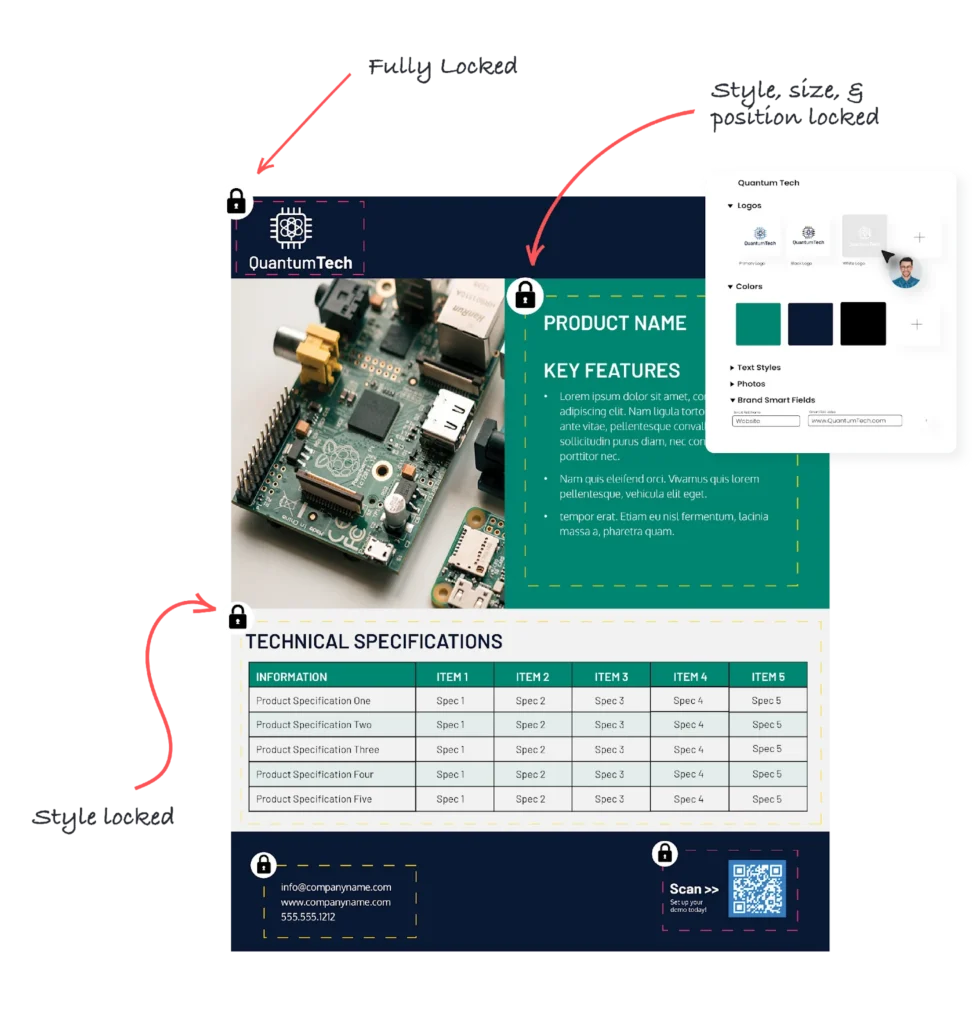
Engel & Volkers, for example, used this approach to overcome what they described as the “wild west” of brand inconsistencies. By using locked templates, they scaled creative production across offices while preserving brand guidelines. Every advisor could create materials on their own, but only within the boundaries the brand team set.
3. Approval workflows before publishing
In distributed organizations, it’s natural for content to go live without ever being reviewed. This is especially common in fast-moving industries like real estate, tech, and finance, where reps are creating and sharing materials on tight deadlines.
The best distributed marketing setups establish a marketing approval workflow that makes sure the right people sign off before anything reaches the market.
4. Role-based permissions
Not every user needs access to everything. A regional sales rep doesn’t need to edit a master template. A franchise partner doesn’t need access to internal campaign assets. Role-based permissions define exactly who can view, edit, or publish what. The right people get the right access, nothing more.
5. Multi-location visibility and reporting
When you’re managing content across dozens or hundreds of locations, you need to know what’s happening on the ground. Which templates are being used? Which offices aren’t engaging at all? Where is content getting stuck in approvals? Without this visibility, marketing leaders can’t make the best decisions. That visibility is a core part of effective multi-location brand management.
With a distributed marketing platform tracking activity across every location, you get real data to work from.
The shift from centralized control to controlled decentralization
For years, organizations have run marketing from the center. Partly because they worried that any content going out without a final review from the brand team would damage consistency.
This took time, effort, and constant back-and-forth. And as companies expanded across regions, franchises, and partner networks, it became near impossible to review everything manually.
Some chose to give complete autonomy to local teams and hoped the brand guidelines would be enough to keep things on track. But that’s what it was: a hope.
Now, with distributed marketing platforms like Marq, you can keep full control over your brand while still giving creative freedom to local teams wherever necessary. Brand admininstrators build the templates, lock the elements that shouldn’t change, and share the assets teams need to do their jobs. Local teams execute freely within those guardrails.
| Model | How It Works | The Tradeoff |
| Centralized | One team creates and approves everything | Brand stays consistent, but production is slow and the team becomes a bottleneck |
| Decentralized | Local teams create freely with access to guidelines | Content creation is fast, but brand consistency and compliance suffer |
| Controlled decentralization | Central team sets the rules, local teams execute within locked templates and workflows | Speed and consistency at the same time |
6 steps to build a scalable distributed marketing system
Getting the right platform is one thing. Building the system around it is another.
Here’s a step-by-step framework for marketing leaders rolling out distributed marketing across their organization.
1. Audit your current content operations
Before you make any changes, map out what’s happening today. Where are your brand assets stored? Who’s creating content, and with what tools? Where are the bottlenecks that slow down production? And most importantly, where is content going off-brand, and why?
Some of the patterns you’ll uncover are:
- Assets scattered across shared drives, Slack, and email
- Repetitive design requests bury central teams
- Local offices are creating their own materials out of sheer frustration
- Outdated and off-brand files still circulating
Once you have a clear picture of where things stand, you can start building a system that solves the right problems.
2. Define what’s locked vs. what’s flexible
You don’t need to control everything, and you don’t need to leave everything open either. The most effective distributed marketing systems draw a clear line between what the brand team owns and what local teams can adapt.
Here are some elements you’d typically lock inside a template:
- Brand colors, typography, and logo placement
- Layout and overall design structure
- Legal disclaimers and compliance language
- Core messaging and taglines
And here are some elements you can leave open for local teams:
- Office addresses and contact details
- Regional offers and promotions
- Staff headshots and team photos
- Localized copy and market-specific imagery
This can vary depending on your industry, team structure, and risk tolerance. For example, a healthcare network will lock more than a retail franchise, but the important thing is making the decision up front.
Once those boundaries are set, build them directly into your templates. Lock the elements that shouldn’t change at the design level so local teams don’t have to guess what they can and can’t touch. The template itself becomes the rulebook.
With Marq, the brand team can lock certain parts of a template and then control editing by role.
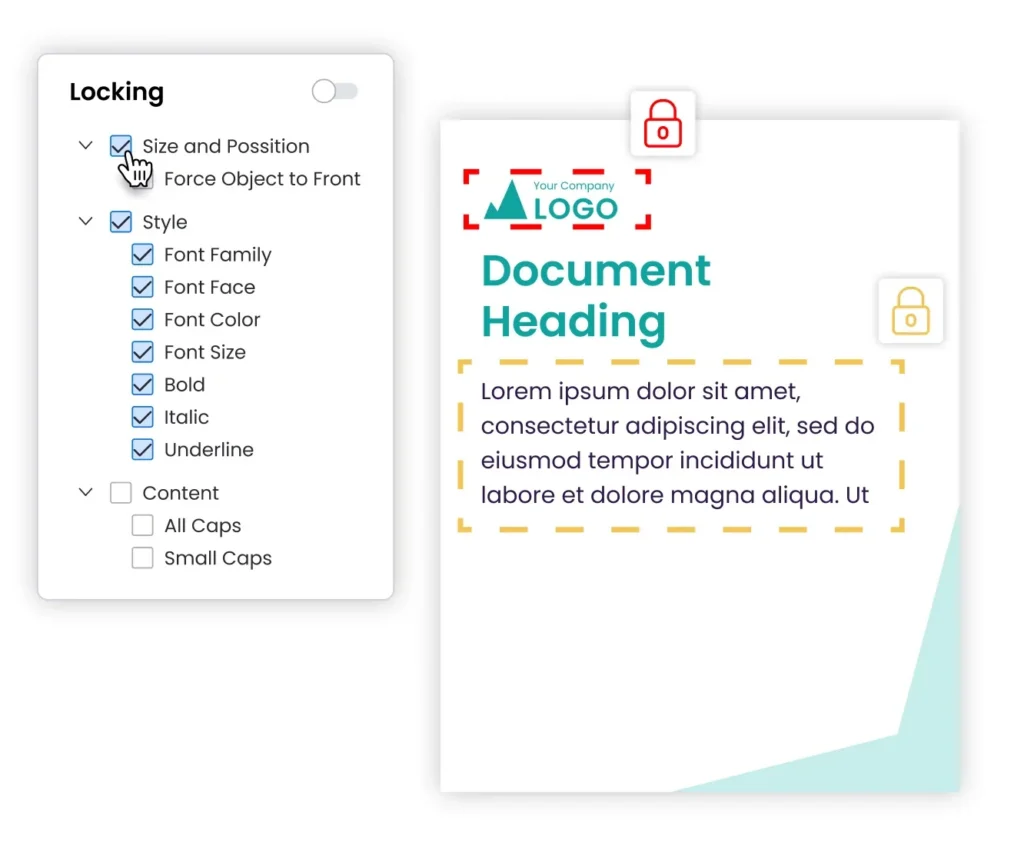
You can also define who gets what level of access. For example, a franchise partner doesn’t need the same permissions as a regional marketing lead, or a field sales rep shouldn’t be editing master templates.
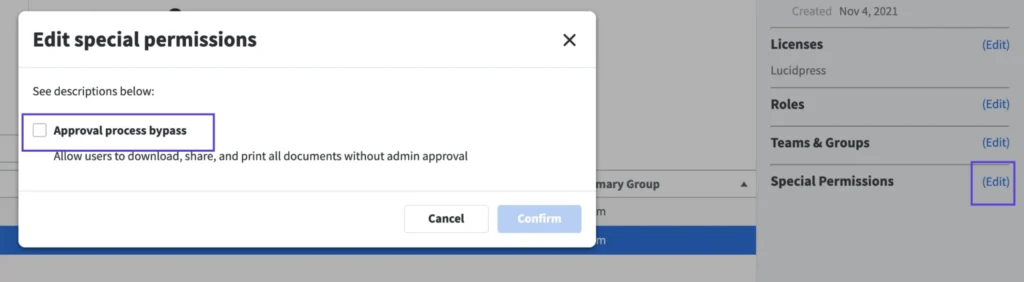
You can even control who bypasses the approval process entirely, allowing specific users to download, share, and print documents without admin approval when the risk level is low enough to justify it.
Setting these roles upfront prevents confusion later and keeps the system clean as you scale.
3. Build approval workflows into the process
Content that skips review carries risk. But, at the same time, routing every asset through the brand team defeats the purpose of distributed marketing.
An easy fix for this is setting up tiered approvals. Not everything needs the same level of oversight, so you define the review process based on the level of risk.
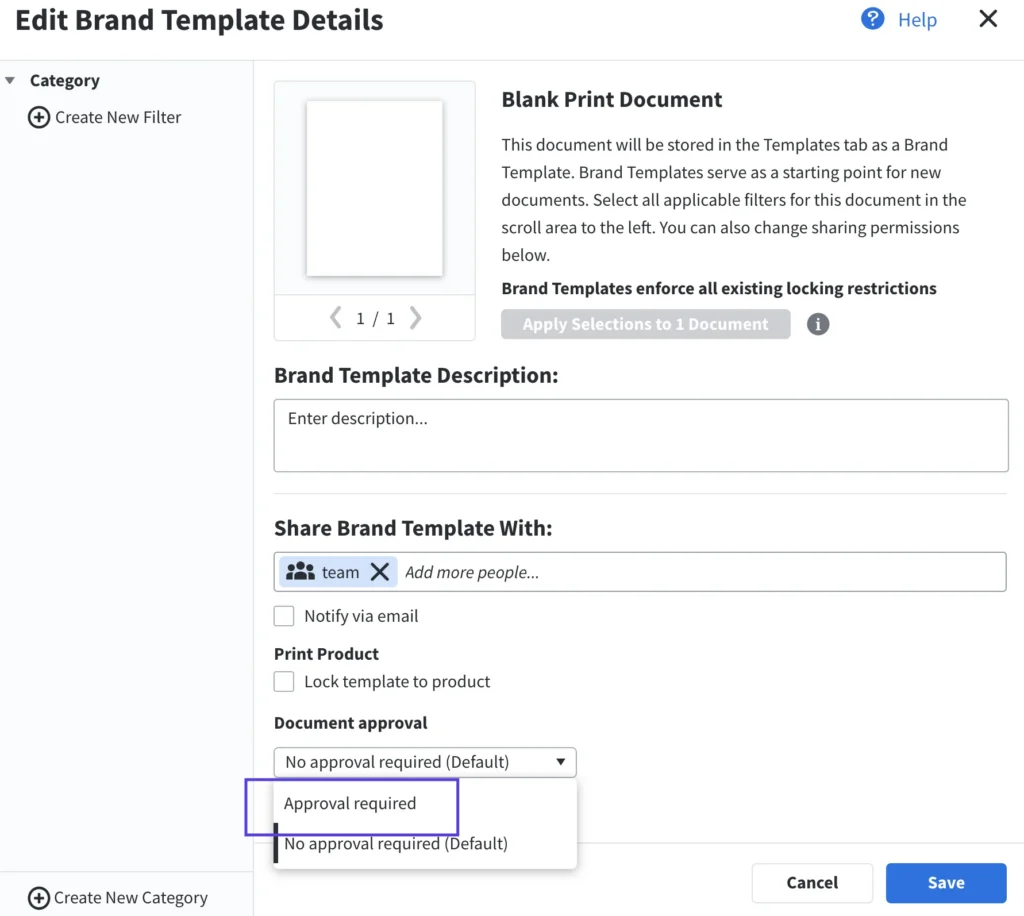
For example, low-risk changes like updating contact details or localizing an offer within a locked template can go live without manual review. The template itself does the quality control here. High-stakes changes like new campaign creative, compliance-sensitive content, or anything that goes beyond the template can trigger a full approval workflow before distribution.
4. Get buy-in and onboard local teams properly
A distributed marketing system only works if people actually use it. Your role is to educate local teams on the system and show them how the platform makes their job easier.
This also includes role-specific training. A regional sales rep needs a different walkthrough than a franchise partner or a campus marketing coordinator. Show them how to find templates, customize what they need, and publish. If the process feels faster than what they were doing before, they’ll stick with it.
You could set up interactive presentations, learning modules, or short video walkthroughs to make onboarding scalable across locations.
This is exactly what Purdue University does. Their central Marketing and Communications team provides predefined, branded templates through Marq that departments across the entire university system can access and customize.
Teams across alumni relations, admissions, donor events, fundraising, and student recruitment all work from the same set of branded templates, personalizing content for their specific audience without going off-brand.
Rather than giving every college and research office full creative control, they manage access through a license request system and provide a dedicated user guide to help teams work within the brand.
Their team also led training sessions to help local departments understand how to use Marq, which played a major role in driving adoption across the institution.
As Kelly Hiller, Exec. Director of Creative Services at Purdue University, put it: “Marq made our design team of four feel like an army of 40.”
The result is consistent output across a massive, distributed institution without the central team becoming a bottleneck.
5. Integrate with your existing tech stack
Make sure your distributed marketing platform integrates with the tools your teams are already using. A system that lives in a silo becomes another tool nobody touches.
Using Marq’s smart fields, for example, you can pull data straight from your Customer Relationship Management (CRM) tool, spreadsheets, or other systems and automatically fill names, locations, pricing, and product details into templates.
You can even generate local or regional versions in bulk. Its creative automation can handle large-scale translations for multi-language campaigns.

In real estate, for example, agents can pull MLS listing details and headshots directly into templates through Marq’s smart fields, then push finished materials to print, social, or web in a few clicks.
Purdue also integrated their PhotoShelter library with Marq so teams can drag and drop approved images directly into templates without leaving the platform.
Explore all Marq integrations here.
6. Measure, iterate, retire
Once the system is live, it’s time to optimize. Track which templates are being used, by whom, and where. Look at which offices aren’t engaging and where content is getting stuck in approvals.
Marq’s analytics give you this visibility out of the box. You can filter usage reports by individual, team, or location, identify your most popular and underperforming templates, and track outstanding approvals, all from one dashboard. You can even export reports across your organization with a single click.
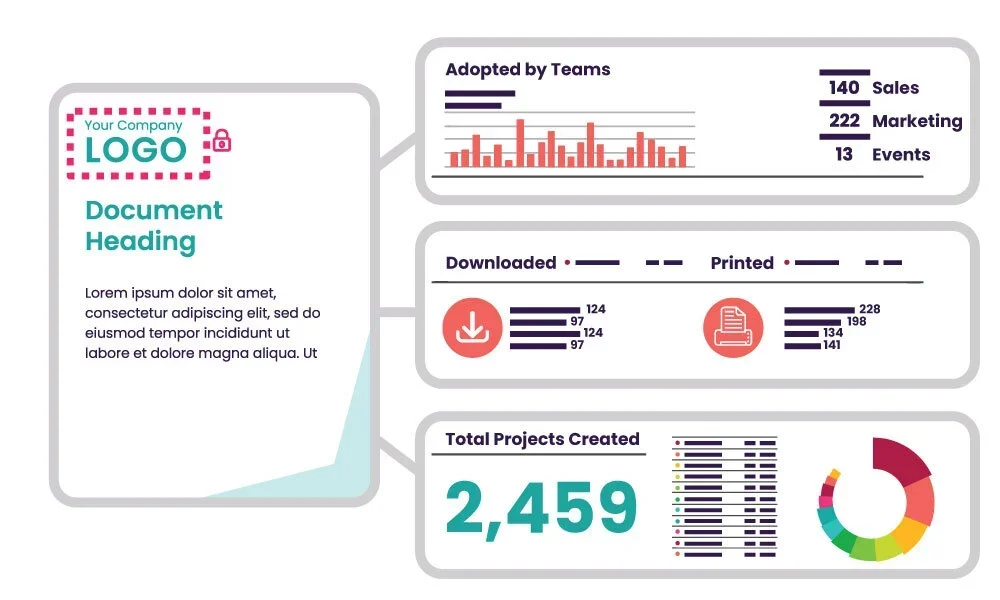
Use this data to inform your next moves. Retire assets that nobody touches or that are underperforming. Double down on templates and content types that local teams are actually using and that are getting results.
Where most distributed marketing strategies fail
Having the right platform and framework doesn’t guarantee success. You still have to put in the work to make it stick. Here are the five most common mistakes:
- Over-centralizing content production: When the brand team tries to control every output, you’re wasting local teams’ time and effort waiting around for basic materials.
- Skipping onboarding: Deploying the platform without explaining how to use it is a recipe for disaster. You’ll have low adoption, and teams will revert to their old workarounds within weeks.
- Ignoring local market needs: Pushing the same national campaign across regions without room for adaptation doesn’t work. Local teams disengage when the materials don’t fit their audience.
- No approval structure: Without a review process, off-brand and non-compliant materials can reach customers before the brand team even knows they exist.
- No feedback loop: If no one is tracking which templates teams use, which they ignore, or where content gets stuck, there’s no way to improve the system over time.
How Marq helps you scale distributed marketing
Building a distributed marketing system isn’t an overnight process. As your teams grow and as you expand into different markets, your content demands will increase.
You’ll need buy-in from local teams, repeatable processes, proper onboarding, and constant iteration until the system works for your organization.
Marq is a distributed marketing management software that lets you do all of this from a single platform. You can manage your team with role-based permissions, lock and distribute templates at scale, set up approval workflows, and track performance across every location.
The platform also offers creative automation, and integrates with CRMs and DAMs like Salesforce, HubSpot, PhotoShelter and others to keep your entire process in one place.
Whether you’re managing a multi-location healthcare, a real estate, or insurance organization, Marq gives everyone a way to create personalized, on-brand content at scale.
Book a demo to see how Marq works for your distributed team.
FAQs
Distributed marketing is the process of enabling local teams, partners, or offices to create and publish marketing content while the central brand team maintains control over templates, assets, and approvals.
Large organizations with multiple locations, franchises, or partners need a way to scale content production without sacrificing brand consistency or compliance across every market they operate in.
Industries with multi-location or partner-driven models benefit most from distributed marketing. This includes healthcare, financial services, insurance, real estate, higher education, franchises, and manufacturing.