Global branding strategy: A guide for marketing and brand leaders

Marketing leaders taking a brand across borders often encounter a familiar tension. Headquarters wants the brand to remain recognizable everywhere, while regional teams need room to make content relevant to their local audiences.
Both needs matter, and the challenge grows with every new region because more people are adapting the brand for different markets.
Send every local version back to a small central team, and that team becomes a bottleneck. Leave each market to improvise, and the brand starts to look different from one region to the next.
A global branding strategy gives both sides clear boundaries. It defines the promise every market shares, what local teams can adjust, and what evidence and approval each exception requires. The goal is simple: keep the core brand consistent while giving each market enough flexibility to make it relevant.
This article covers the decisions that make it work: what stays fixed, what regional teams can change, who approves exceptions, how localization gets reviewed, and where Marq fits once the strategy is set.
Why global branding becomes difficult as brands expand into new markets
Every new market demands legitimate changes. The language changes. Imagery that lands in one country falls flat in another. Offers, formats, and legal disclosures shift by region. Through all of it, customers still need to recognize the brand as the same company.
The trouble starts when regional teams do not know what they can change or when they need sign-off. Some wait on headquarters and miss their launch window. Others improvise, and off-brand materials start circulating.
In Marq’s survey of more than 400 organizations, 33% of respondents said that stronger brand consistency had helped increase revenue by more than 20%. When consistency breaks across regions, you lose the trust and recognition that drive that lift, and customers have to relearn who you are in every market.
Here is where global branding usually breaks:
- Brand drift across regions. Each market reads the guidelines differently, so a logo gets stretched in Sydney and the palette shifts in Toronto.
- Slow or late localized assets. A small central team can struggle to produce every market variant by deadline, so campaigns launch late.
- Translation and cultural missteps. A tagline that works in English reads as awkward, or offensive, once translated without in-market review.
- Version chaos. People edit old files offline and email them around, and nobody knows which version is current.
- No central visibility. Headquarters can’t see what each market publishes, so problems surface only after they reach customers.
These failures compound. One late launch trains that team to improvise on the next one, and off-brand shortcuts spread fast. The rules only hold when they live inside the templates people use, not inside a PDF nobody opens.
Global branding strategies for scaling brand consistency
This section lays out five decisions that make a global branding strategy workable. Each part answers one decision every marketing leader faces when a brand crosses borders. Together, they define a repeatable system for adapting the brand across markets.
| Strategy | What it settles | Who owns it |
| Decide what’s fixed and what changes | What stays fixed vs. what local teams can change | Central brand |
| Centralize the brand system | Where the current rules, assets, and templates live | Brand operations + DAM owner |
| Localize with in-market review | How language and cultural fit get checked before launch | Regional marketing + localization + legal |
| Govern approvals and exceptions | Who signs off on changes, across time zones | Brand + legal/compliance |
| Measure consistency and performance | Whether the strategy works, globally and per market | Brand insights, regional analytics, media, and operations |
1. Decide what stays consistent and what local teams can change
This is the central decision in global branding, and everything else depends on it. Treat these categories as starting defaults. For each element, document the global default, the evidence required for a market-specific exception, who proposes the change, and who approves it.

Keep global brand standards consistent with Marq
Lock critical brand elements while giving regional teams the flexibility to customize approved copy, imagery, and other market-specific content.
| Brand element | Global default | Local adaptation allowed? | Who approves the change |
| Name and logo | Fixed everywhere | No | N/A |
| Color and type | Fixed everywhere | No | N/A |
| Brand values | Fixed everywhere | No | N/A |
| Voice and tone | Fixed principles | Slight, for local idiom | Regional marketing |
| Body copy | English source | Yes, translate/transcreate | Regional marketing + localization |
| Imagery | Approved library | Yes, swap for local relevance | Regional marketing |
| Offers and pricing | Set by market | Yes | Regional lead + finance |
| Legal disclosures | Varies by market | Yes, required | Legal/compliance |
For every flex item, write down four things: the global default, the evidence that justifies a local change (customer data, market norms, or a legal requirement), who proposes it, and who approves it. Global brand owns the default, regional marketing supplies the evidence, and legal reviews its own domain.
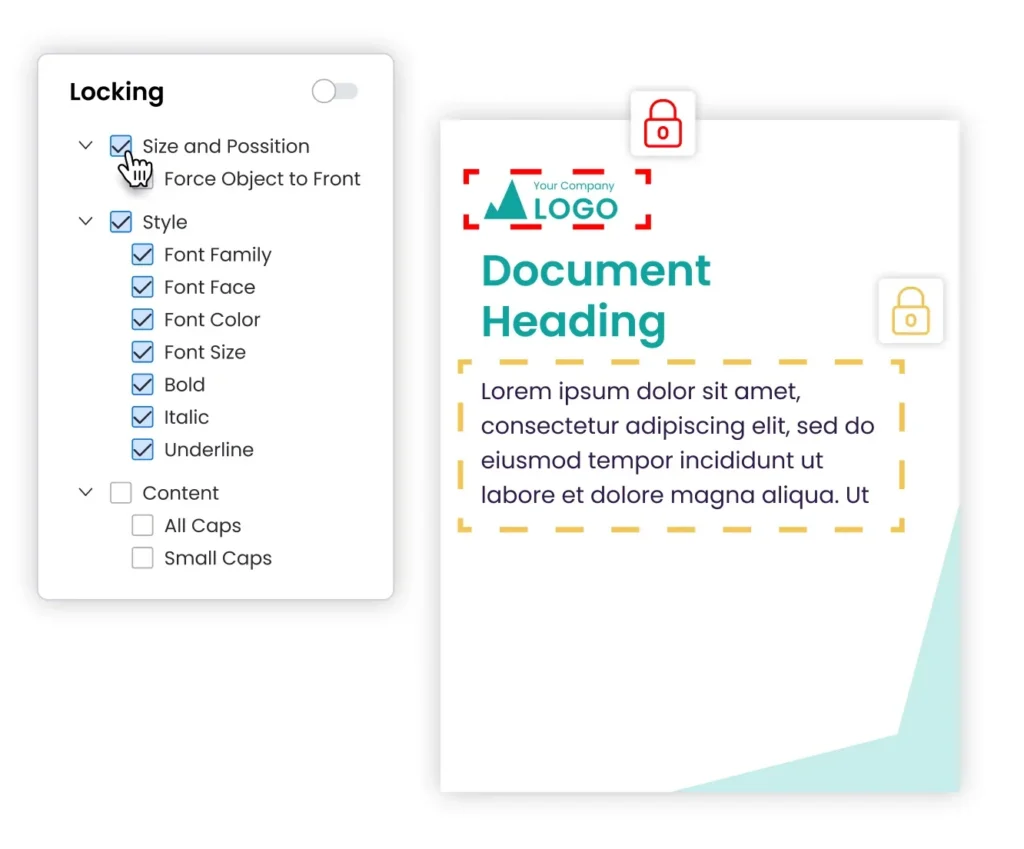
Once those rules are agreed on, Marq can build them directly into the template. The crest, colors, and other brand-critical elements can be locked so local teams cannot change them, while editable fields let teams update photography, copy, and other approved content for their market.
2. Build a centralized global brand system
A split between core and flex only holds if everyone works from the same current source. A centralized brand system gives every market one place to find the approved rules, assets, and templates.
Set up the handoff in this order:
- Global brand publishes the current rule and the criteria for exceptions.
- The DAM or asset owner maintains approved source assets, rights, versions, and expiration dates.
- Creative turns recurring designs into templates, importing finished work from Adobe InDesign.
- Brand operations configures editable and non-editable fields plus access permissions.
- Regional users create local variants from those templates.
- Named owners review any exceptions.
- Operations updates guidance, assets, and templates together so nothing goes stale.
A word of caution on any rule you build into a template: a legal line you set once can still go out of date or turn out wrong for a market. Legal owns whether a claim is correct; the platform only preserves what an admin configured. Review those lines on a schedule.
At enterprise scale, a DAM may remain the system for approved assets, rights, metadata, and versions. Marq can make those same assets available and help users activate them inside governed brand templates, getting them into the hands of every regional marketer, seller, and partner who needs to build something on-brand.
3. Build localization and in-market review into the workflow
Translation alone does not make a brand work in a new market. You need a review step that checks language, cultural fit, and legal accuracy before publishing. Build it into the workflow so it happens every time, not just when someone remembers.
Run localization in this sequence, and name the output of each step:
- Approve the source copy and mark the editable fields. Output: a stable master template.
- Write a localization brief covering audience, terminology, tone, formats, imagery, claims, and disclosures. Output: clear instructions for the local team.
- Translate or transcreate the copy. Output: draft market copy.
- Regional marketing reviews market and cultural fit. Output: copy that reads as native.
- Route legal, privacy, or IP questions to the right reviewer. Output: cleared claims and disclosures.
- Produce the local template variant. Output: a market-ready asset.
- Run linguistic and visual QA. Output: a checked, publishable file.
Split translation from transcreation. A legal disclaimer needs qualified translation and local legal review; a campaign tagline may need transcreation to preserve its intent rather than its exact wording.
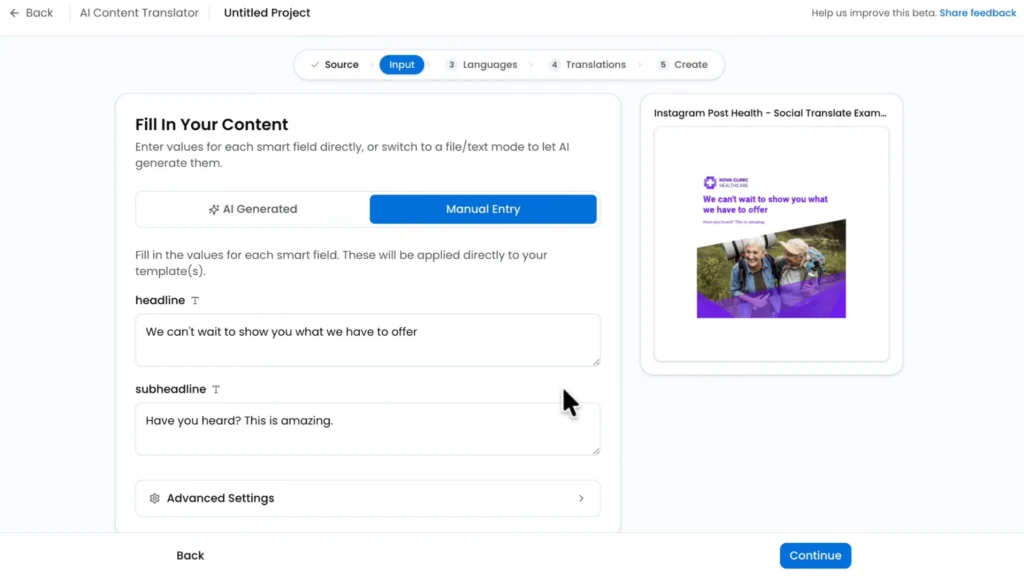
The Marq platform preserves your template structure and editable fields, and connects governed templates to supported translation workflows like BLEND, Lokalise, and Crowdin.
Its AI Content Translator generates a first-pass localized version in minutes; treat that as a draft, not a finished asset. Your people still confirm the language is accurate, the tone fits, and the claims comply.
4. Govern approvals and exceptions
Global speed dies in unclear approvals. When a regional team doesn’t know who signs off, they either wait or skip the step. Brand governance is the set of rules that decides who can change what, what needs review, and how exceptions get handled. Done well, it gives teams speed without letting the brand drift.
For each type of change, write down five things:
- Who decides. Name the owner, not a department.
- What requires approval. List what always needs sign-off (new claims, legal disclosures, logo use) versus what teams can do freely (swapping approved photos, translating copy).
- What evidence is needed. State what a regional team must show to justify an exception.
- Who acts as backup. Cover time zones. A request in Singapore can’t wait for someone in Utah to wake up.
- How exceptions get recorded. Log the decision so the next team can follow it.
An insurance company running campaigns across several states requires legal sign-off on any policy claim, but lets regional teams publish event flyers and agent bios on their own. The high-risk change goes through review; routine work can proceed the same day.
The Marq platform can support this and restrict configured edits and require approval before users download, print, or publish a project.
Give every market access to the right brand resources
Using Marq, centralize approved templates and assets so your regional teams can create localized content without relying on outdated files or starting from scratch.
5. Measure the performance of your global branding efforts
A global branding strategy is a loop, not a launch. Track how the brand holds together and performs in each market, then feed what you learn back into the brand book, templates, and campaigns.
The point of measurement is to change a decision. A few examples:
- Template adoption stays low in one region. The template doesn’t fit their formats, so build a variant that does.
- Localized assets take three weeks to clear review. A slow approval step is stalling, so add a regional backup approver.
- One market’s campaigns consistently outperform. Document the play and offer it to other regions.
Case studies and examples of successful global branding workflows
Real teams show how these frameworks play out. Each example below covers the challenge, what the team did, the result, and the takeaway for marketing leaders.
1. Yext
Challenge: A seven-person creative team supported 1,200+ employees across 18 locations in 10 countries. A messaging initiative required 100+ sell sheets in multiple languages, which no small team could produce by hand on deadline.
What they did: The team built a single accessible master template in Marq, with critical elements fixed and language fields left editable. They designed the structure once, then let international team members translate the content for their own markets.
Result: The creative team supported a repeatable, multilingual sell-sheet workflow inside brand guidelines. Producing the next batch of localized sell sheets became a translation task for regional teams rather than a design project for the central seven.
Takeaway for marketing leaders: Yext’s case shows how a master template can help a small creative team support multilingual sell sheets while international teams translate editable content for their markets.
“Marq gives us the ability to [present the brand consistently] by allowing others to have the freedom to create these assets on their own while still adhering to our brand guidelines.” – Alex Felsenstein, Creative Director, Yext
2. PT Solutions
Challenge: PT Solutions, a healthcare provider, grew to 550+ locations across 25 states. Its creative team was buried under 300+ monthly requests, most of them repeatable, while outdated collateral with stretched logos circulated across locations.
What they did: The team paired Marq templating with its MediaValet DAM. Designers imported InDesign files into Marq, field teams created their own collateral from brand-approved templates, and finished materials pushed straight back into the DAM as a single source of truth.
Result: Flyer turnaround moved from two-to-four weeks down to same day, and teams self-served 300+ projects a month across 550+ locations.
Takeaway for marketing leaders: This national example shows how governed templates can let local teams create approved materials without routing every request through the central team.
“Turnaround times were growing, and the cracks in our creative process were starting to show.” – Malia Hostetler, Senior Manager of Creative Solutions, PT Solutions
3. Berkshire Hathaway HomeServices
Challenge: Regional Berkshire Hathaway HomeServices brokerages needed to keep every agent on-brand and compliant without routing every request through a small marketing team.
What they did: Marketing loaded its creative files into Marq and let agents customize templates themselves, with brand elements held fixed.
Result: Marketing stayed in control of the brand across agents and materials, printed or digital, while agents produced their own on-brand assets.
Takeaway for marketing leaders: In real estate, self-serve templates keep independent agents on-brand without slowing them down.
“The ability to take our creative files, load them into Marq, and allow our agents to customize the templates themselves has been absolutely wonderful and really takes a load off my marketing team.” – Chrissy Kincheloe, Marketing Director, Berkshire Hathaway HomeServices Carolinas Realty
Common mistakes to avoid when scaling your brand globally
The table below connects six common global branding mistakes to an immediate risk and a fix.
| Mistake | Business impact | Fix |
| No global brand book | Every region interprets the brand differently; teams rebuild from scratch | Publish one brand book and connect it to the templates people use |
| Over-standardizing | Local content feels irrelevant or unusable | Define a flex list so regional teams can adapt language, imagery, and offers |
| Unclear ownership and approvals | Brand drift; stretched logos and off-message flyers circulate | Set brand-safe templates with lockable fields and required approvals |
| Skipping cultural and legal review | Mistranslations and non-compliant claims reach customers | Route claims and disclosures to in-market reviewers and legal before publishing |
| No measurement plan | The same mistakes repeat every launch | Track consistency and time-to-launch, then feed findings back into templates |
| Too many file versions | Teams publish old files; nobody knows the current version | Keep current assets and versions in one source of truth such as your DAM, and activate assets through governed templates |
Marq helps with corrections that involve approved assets, templates, controlled fields, permissions, approvals, and operational visibility. It does not fix market strategy, cultural judgment, translation quality, or legal interpretation.
KPIs and metrics marketing leaders should track for global branding success
Split your metrics into four groups, and assign each group an owner. Each metric informs a specific decision, and none proves causation on its own, so track the operational metrics you control directly and read the outcome metrics as signals.
| Metric group | What to track | Who owns the source |
| Brand health | Awareness, consideration, brand associations, equity | Brand tracking / research |
| Market outcomes | Conversion, revenue, market share, retention | CRM, commerce, finance |
| Campaign performance | Reach, frequency, brand lift | Media and experiment systems |
| Content operations | Template adoption, asset freshness, localization and approval time, rework, exceptions | Marq and adjacent workflow systems |
Split each metric into a global and a local view:
- Global metrics: brand consistency across markets, awareness and equity, and time-to-launch in a new region.
- Local metrics: localized-asset adoption, market conversion, and sentiment per region.
Time-to-launch is a content-operations metric. If it increases, investigate where localization or approval is stalling before opening the next cohort.
Marq supplies template usage, adoption, asset freshness, and approval-status signals, while adjacent localization or workflow systems supply cycle-time data. Brand health, market outcomes, and campaign performance come from your research, finance, and media systems. See Marq’s analytics for operational reporting.
Where Marq helps marketing leaders apply an approved global branding strategy
Once management approves the strategy, the Marq platform puts it into practice. People own the strategic, market, linguistic, cultural, and legal decisions, and a DAM owns deeper asset rights and versioning. Marq turns approved designs and data into governed template execution, access, approvals, and usage reporting, so a central team can hand regional marketers, sellers, and partners materials they can adapt without starting from scratch.
Key features
- Templates with lockable elements. Fix the logo, colors, and legal lines while leaving text and images editable, so regional teams stay on-brand and still move fast.
- Smart fields. Smart fields can auto-fill mapped profile, team, custom, or connected data in templates; output like contact details, disclaimers, and layouts change automatically based on the market, location, or role.
- Data automation. Connect supported data sources like a spreadsheet or CRM to populate mapped template fields and personalize content automatically.
- InDesign-to-template workflow. Designers keep working in Adobe InDesign, then convert finished files into governed templates for self-service.
- Localization support. Connect templates to supported translation workflows (BLEND, Lokalise, Crowdin), plus an AI Content Translator for a fast first draft.
- Approval controls. Require approval before users download, print, or publish configured projects.
- CRM and DAM integrations. Connect supported systems, including Salesforce, HubSpot, Bynder, Brandfolder, and MediaValet.
- Usage analytics. See which templates regional teams actually use, and where adoption lags.
Pros
- Marq can reduce routine production requests by letting distributed teams customize approved templates while central teams control protected elements, access, and review steps.
- The InDesign import lets designers keep their craft while still enabling safe self-service.
- Data automation turns hundreds of manual edits into a single run.
- Scales content creation for multi-location and multi-brand organizations in real estate, higher education, financial services, insurance, healthcare, and manufacturing, while keeping the brand recognizable.
Cons
- Built for distributed content needs, so a solo team or a business that only needs static storage will find it more than they need.
- Pixel-perfect, one-off creative still starts in a design application, then comes into Marq for scaled reuse.
Best for
Marq is a strong fit for mid-market and enterprise organizations with a central brand or creative team supporting many distributed non-designers who regularly create local versions of approved materials. If a lean creative team supports many contributors who all need on-brand materials fast, Marq fits.
Put your global branding strategy into practice with Marq
A global brand holds together when you make five decisions on purpose: what stays consistent across markets, what regional teams can customize, who approves exceptions, when to review those rules, and how to measure the result.
Regional marketing, localization, and legal still own local relevance, translation quality, and legal review. The framework reads simply: a consistent global core plus local flex, held together by a central brand system and clear governance, and improved by measurement. Marq puts those approved decisions into practice through governed templates, permissions, approval controls, integrations, and usage reporting.
Book a demo to see Marq applied to your markets.
FAQs
What is a global branding strategy?
A global branding strategy is a plan that keeps one recognizable brand across every market while letting local teams adapt language, imagery, and offers to fit their region. It defines what stays fixed and what can change.
What is the difference between global branding and localization?
Global branding sets the consistent core that customers recognize everywhere. Localization adapts the flexible parts, like language and imagery, for a specific market. You need both working together.
How do you keep a brand consistent across markets?
Define a fixed core, publish one brand book, and build the rules into the templates people use. Add in-market review and clear approval owners so regional teams move fast without drifting off-brand.