2026 Global Brand Management: 7 Frameworks to Scale Worldwide

Key takeaways
- Global brand management isn’t a bigger version of domestic brand management. More markets mean more language, regulations, cultural contexts, and organizational distance.
- Brand consistency often breaks at the regional layers. The middle tier, between HQ and local teams, is where standards get lost, bent to meet deadlines, or simply ignored.
- Translation is not localization. Preserving meaning, adapting layouts for right-to-left languages, and meeting country-specific legal requirements require a system built for it from the start.
- In a global context, you cannot rely on people to remember and follow brand rules across time zones. Locked templates, controlled flexibility, and approval workflows are the only thing that scales.
Your domestic brand system finally works. Templates are locked, designers aren’t drowning in flyer requests, and regional teams know where to find approved assets.
Then the brief changes: extend the system to a partner network in Germany and three franchise regions in Southeast Asia. The template that worked perfectly for one market doesn’t account for three languages, two regulatory environments, or a regional team that’s never heard of your brand guidelines.
Done poorly, the brand drifts, every market looks slightly different, messaging feels off, and eventually the brand stops meaning anything to anyone. Done well, distributed teams create what they need without the central team becoming a bottleneck.
This guide breaks down seven practical frameworks for building a global brand management system that actually holds, and walks through the tools and structures that keep it running at scale.
Why do most global brand strategies break at scale?
Bad strategy rarely causes most global brand problems. It starts with a domestic brand system that worked fine for 200 people in one country, and then got stretched across eight countries, three languages, and a partner network that nobody trained.
The issues that feel annoying at a mid-market company become genuinely hard to manage at a global level:
- More locations mean more content demand.
- More languages mean more translation cycles.
- More markets mean more cultural context to get right.
- More organizational distance means brand guidelines degrade faster.
This happens because the people creating content are further from the people who set the rules.
| Pain Point | Domestic Impact | Global Impact |
| Brand inconsistency | Off-brand flyers, outdated logos | Fragmented brand perception across markets |
| Template violations | One team goes rogue | Systematic drift across regions |
| Translation errors | Rare internal issue | Damaged brand credibility publicly |
| Approval bottlenecks | Slow campaign launches | Missed market windows; teams bypass review |
| Compliance gaps | One country’s legal exposure | Different disclosure rules in 8+ markets |
According to Marq’s brand consistency report, consistent brand presentation can increase revenue by up to 23%. Yet 77% of marketing leaders report seeing off-brand content in the wild – and that’s before layering in global complexity.
The companies that scale their brand successfully treat governance as a non-negotiable, not an afterthought. Instead of relying on people to remember the rules, they build it into the system.
Step-by-step framework for scaling and managing global brands
There is no single success model for global brand management. The right structure depends on how centralized your organization is, how much local autonomy makes business sense, and how mature your brand system already is.
The following seven frameworks apply across industries, from real estate franchise networks to financial services and healthcare systems.
| Step | Framework | Core Question |
| 1 | Map the Brand Latitude Spectrum | What’s fixed globally, what’s adaptable regionally? |
| 2 | Build the Governance Hierarchy | Who owns what and at which level? |
| 3 | Design for Localization First | Can the template handle right-to-left, date formats, and legal copy? |
| 4 | Encode Compliance as a Variable | Which brand rules change by country? |
| 5 | Reduce Organizational Distance | How far does a brand standard travel before it degrades? |
| 6 | Centralize Asset Access | Can every market find the right file in under two minutes? |
| 7 | Measure What Matters | Which KPIs tell you the brand is holding? |
Step #1: Map the brand latitude spectrum
Every element of your brand sits on a spectrum between total standardization and total localization. Neither extreme works at scale. Total standardization ignores cultural context. Total localization destroys brand coherence.
The useful work is deciding, explicitly, where each brand element sits on that spectrum. For example:
- Logo: almost always non-negotiable globally.
- Color palette: typically standardized, but cultural meaning varies (white signals mourning in several Asian markets; red signals luck, not danger).
- Imagery: almost always needs regional adaptation.
- Tone and copy: always needs localization, not just translation.
- Promotional pricing: almost always local.
Why this matters
Brand operators who skip this step will get a slow drift: markets that look slightly different, copy that feels off, imagery that’s technically on-brand but contextually wrong. The Latitude Spectrum forces explicit decisions before the drift starts.
Document the spectrum in a single-page governance map. Distribute it to every regional team and build it into the template constraints. It should act as an authority, not the guidelines PDF that nobody reads.
Step #2: Build the governance hierarchy
Domestic brand governance has two layers: central (the brand team) and local (the person creating the asset). Global adds a third: the regional or market-level manager. Brand standards break in this middle layer more than anywhere else.
The principle here is subsidiarity: the lowest-level managers should make decisions whenever they have sufficient context. When applying this principle to brand management, the global team shouldn’t approve every regional flyer. They should set the constraints inside which regional teams operate.

The governance map should answer three questions for every brand element:
- Is this element globally locked (non-negotiable)?
- Is this element regionally customizable (within defined parameters)?
- Is this element locally owned (market teams have full control)?
Without this map, regional teams will make their own calls under deadline pressure. The template system enforces whatever you’ve decided but the decision has to come first.
How this works in practice
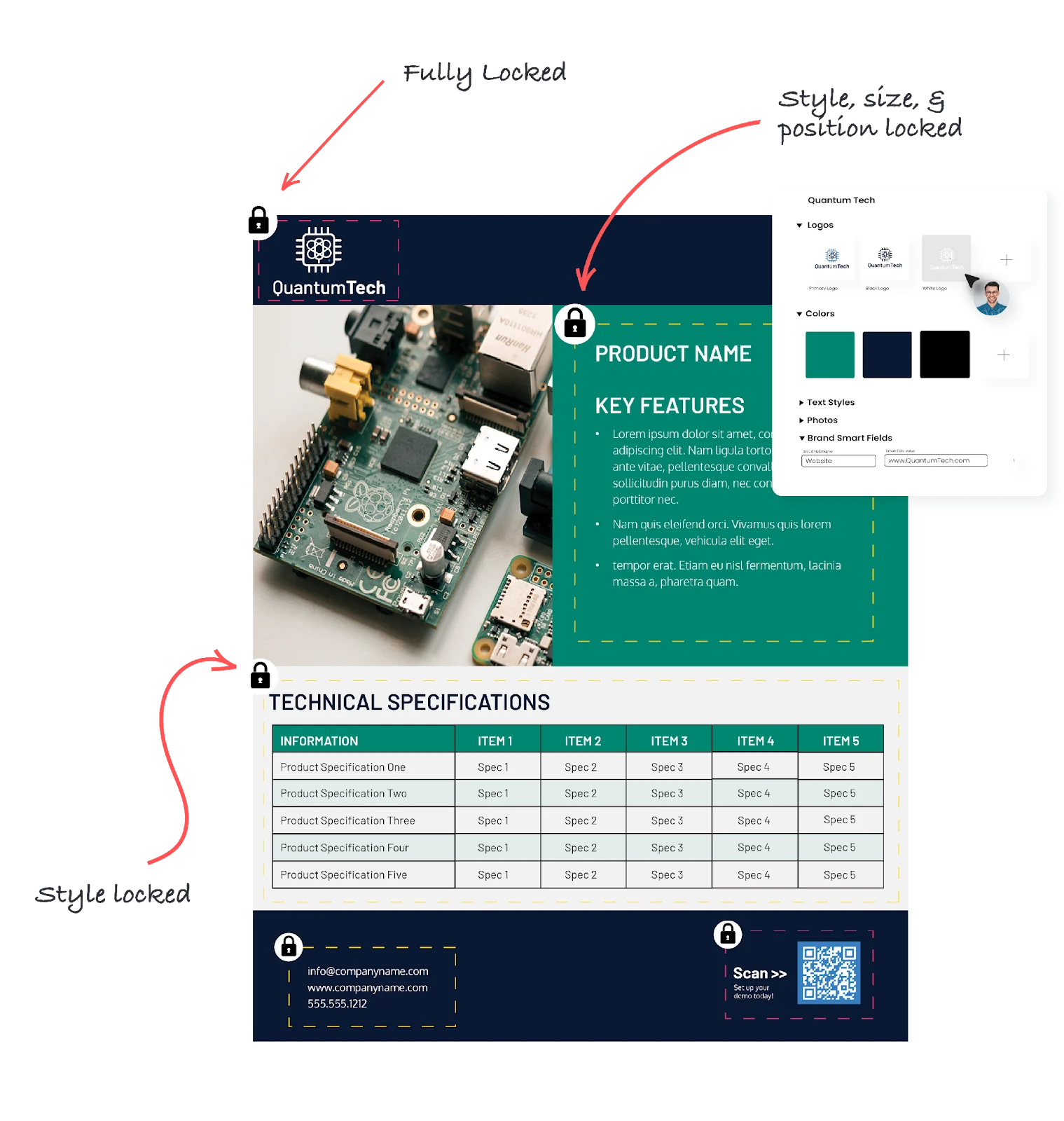
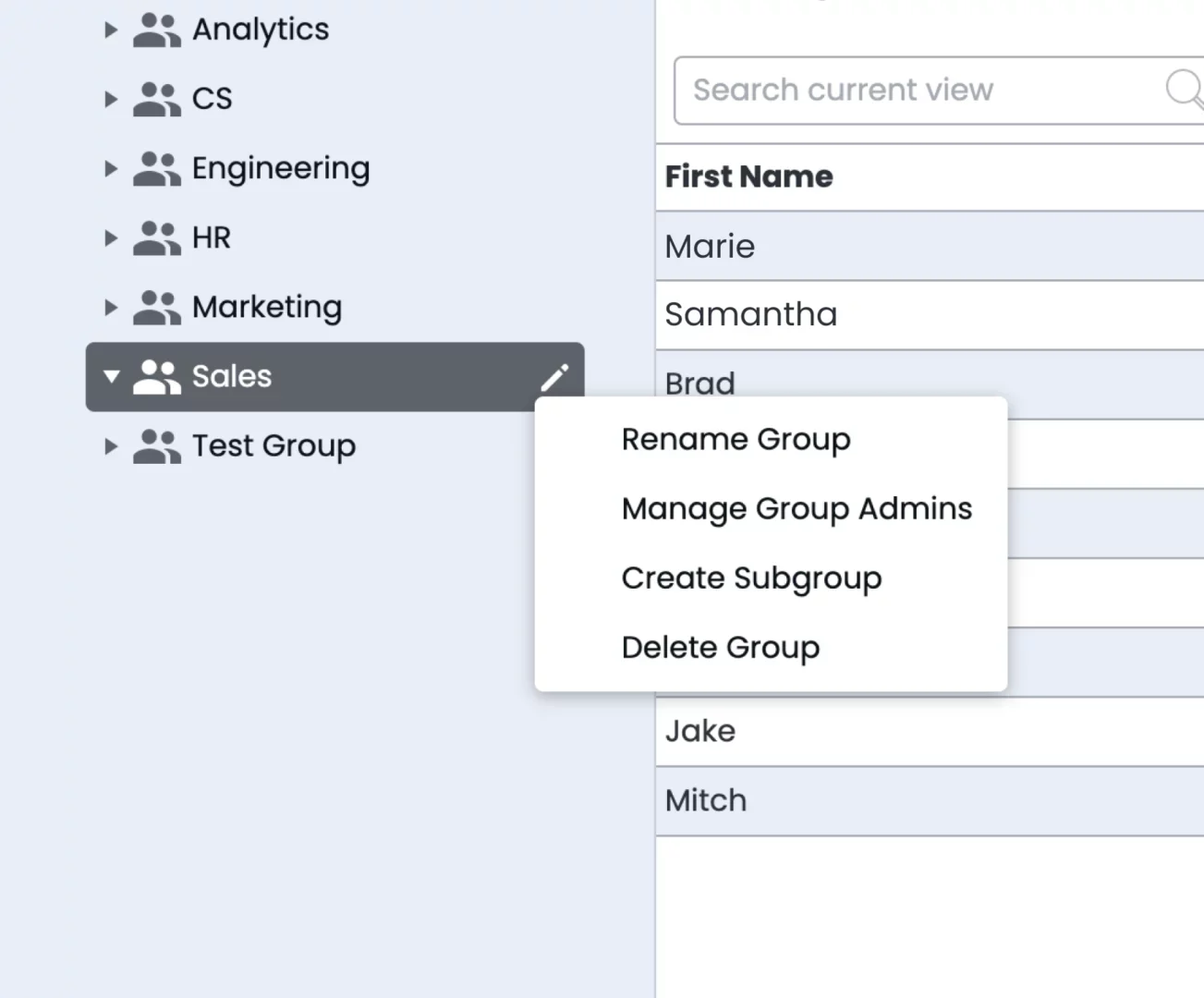
Marq’s lockable templates encode those constraints directly as regional teams get creative freedom within defined limits, and the central team doesn’t become a bottleneck.
Step #3: Design templates for localization from the start
Translation changes words. Localization changes meaning, and often the layout and structure entirely.
Most brand operators underestimate this distinction until a campaign ships in Germany with the wrong date format, or a tagline that worked in English lands as an insult when translated literally.
For example, when companies take templates designed only for English-language markets to a global level, it creates problems:
- Right-to-left languages like Arabic and Hebrew require layout mirrors, not text swaps.
- Date, number, and address formats vary by country.
- Legal disclaimers and required disclosures differ by jurisdiction.
A template that looks clean in the US becomes a formatting mess in a different market if it wasn’t built with localization in mind.
Common mistake: retrofitting templates for localization after the fact.
Teams add a market, copy the existing template, manually swap out text, and send for translation. The result is version sprawl with 40 versions of the same template, none of them properly governed, all of them stored somewhere slightly different.
Marq’s integration with professional translation platforms like Crowdin, Lokalise, and Blend removes the manual step entirely. The template extracts text fields automatically and send them to the translation provider (human, machine, or hybrid). This comes back into a fully formatted, on-brand project.
One campaign, ready in every language.
Step #4: Encode compliance as a variable, not a constant
Brand operators in regulated industries already think about compliance.
Global operators face a compounding version of the same problem: compliance rules differ by country, and the brand team is often the last to know when a regulation changes in a market they don’t directly manage.
GDPR in Europe affects what contact information can appear on materials. Financial advertising regulations vary enormously. For example, what’s a standard mortgage rate disclosure in the US may be insufficient or outright prohibited in the UK or Canada.
Healthcare marketing restrictions differ by country, with some markets banning direct-to-consumer clinical claims entirely. Co-branding agreements with international partners may include their own constraints on logo treatment and placement.
The practical answer: the template governance system needs to encode country-specific rules that go beyond the global brand rules.
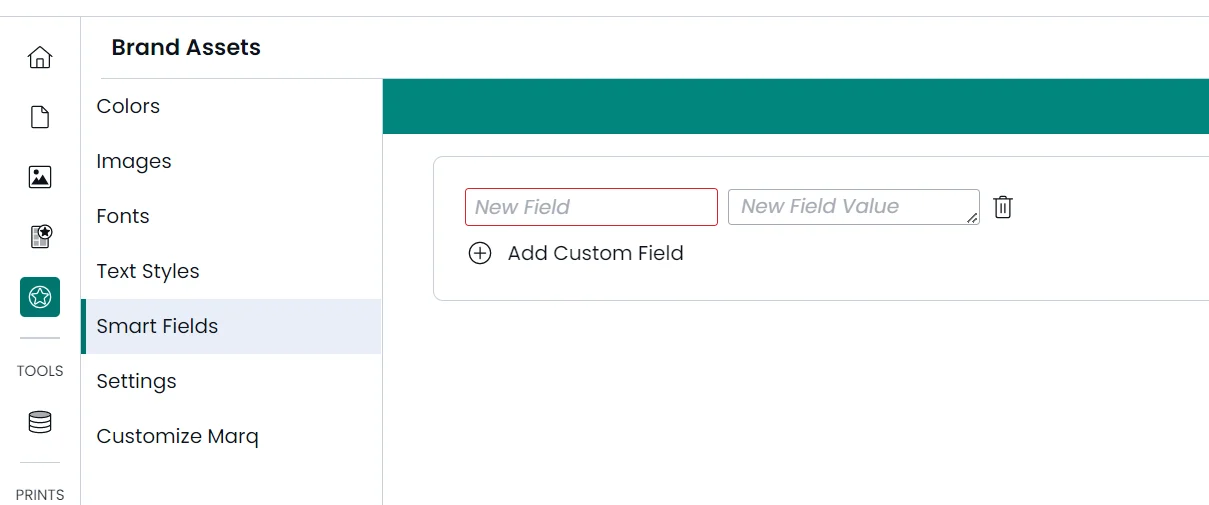
Marq’s Smart Fields handles this. When a financial advisor in Germany opens a template, they see the correct legal disclosures for that market, not the US version.
Did you know?
In financial services, a single non-compliant rate disclosure in a regional market can trigger regulatory review. The average cost of non-compliance (including fines, business disruption, and revenue loss) is $14.8 million, nearly three times higher than the cost of maintaining proactive compliance systems.
A governed template system is proactive legal risk management, not reactive damage control.
Step #5: Close the organizational distance gap
This is the least-discussed dimension of global brand management and the most practically painful.
Managers can correct domestic teams quickly. You can message someone, catch an error before it ships, fix it in an hour. But with international teams that operate in different time zones, languages, and organizational cultures, brand compliance may carry different weight or rank differently as an organizational priority.
Think of it as signal degradation: the further a brand standard travels from its origin, the more it degrades. What feels obvious at HQ becomes ambiguous in a regional office and invisible to a local partner.
Whether it’s a franchise network, a health system, or a financial services brand with a partner distribution channel, the compounding effect is the same: more markets mean more variables, and every one of them creates a new place for brand standards to break down.
The template itself has to do the enforcement. Users cannot change locked elements, regardless of deadline pressure. Approval workflows catch violations before they ship.
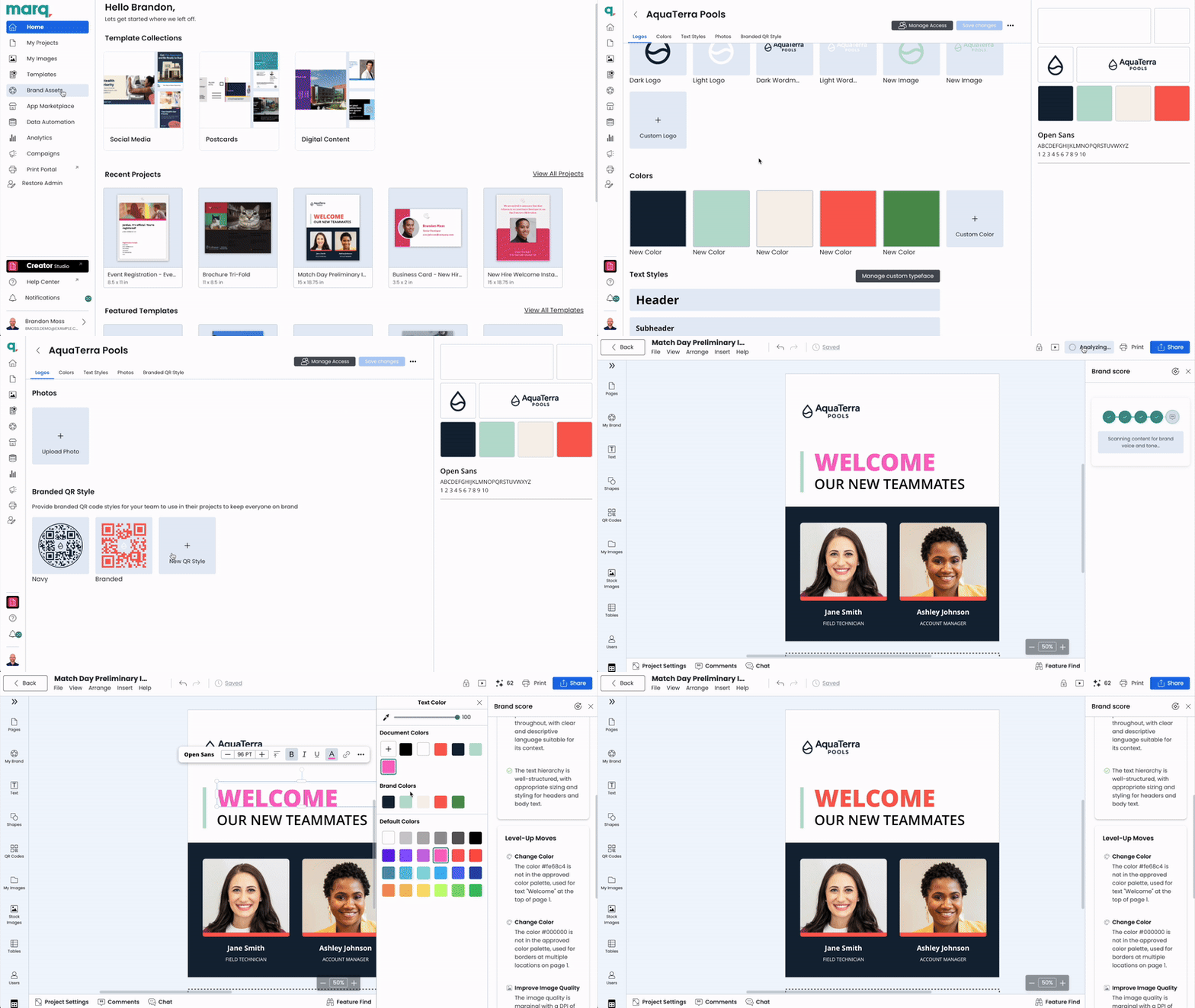
Marq’s Brand Guardian feature functions like spellcheck for your brand by flagging elements that have drifted from approved standards automatically, so the brand team doesn’t have to review every asset manually.
“We’re able to quickly customize assets by market and audience, leading to more powerful marketing.”
— Morgan Turner, Orchard Real Estate
Step #6: Centralize asset access without creating a bottleneck
The goal here is to make the right asset the easiest asset to use. When the approved version is the most accessible version, compliance happens without enforcement.
The most common reason distributed teams go off-brand is friction.
Distributed teams don’t go off-brand because they don’t care about the brand. They go off-brand because finding the right file takes too long. So they use what they can find.
A centralized asset management system solves the access problem. But access alone doesn’t prevent misuse as teams also need to know which creative assets are approved, which are current, and which are restricted to specific markets or use cases.
Marq’s native asset management handles version control and asset governance in the same environment where templates are created. For teams already using a dedicated DAM like Bynder or Brandfolder, Marq integrates directly.
Read more: Marq’s content management capabilities
Step #7: Build a measurement system that reflects global reality
Domestic brand measurement often focuses on brand awar
eness and campaign performance.
Global brand management requires a different set of signals, ones that tell you whether the governance system is holding, whether regional teams are working inside the guardrails, and whether content is reaching markets quickly enough to matter.
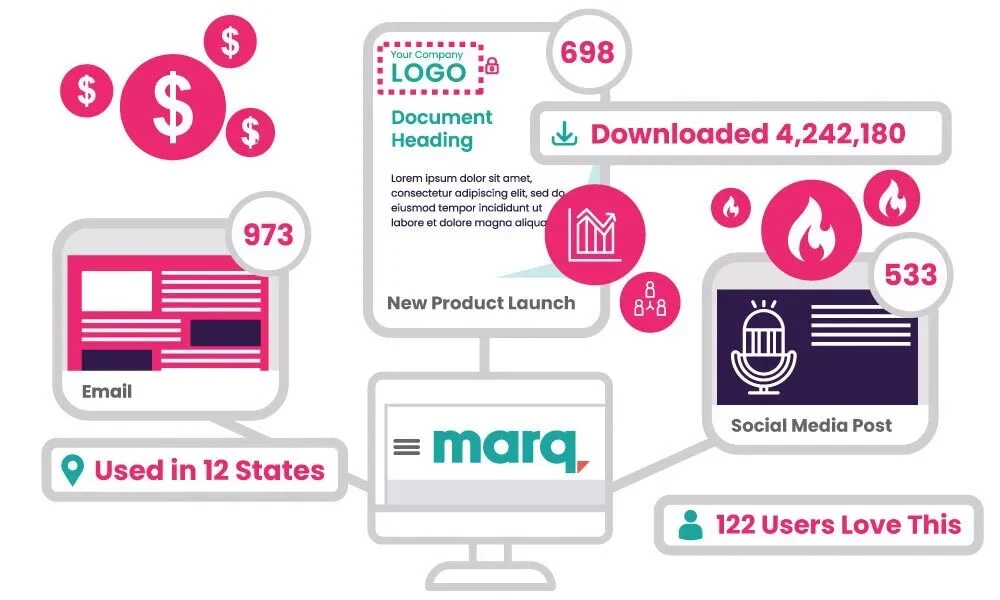
The KPIs that matter most for global brand operations are:
- Asset adoption and reuse rate: Are regional teams using approved templates, or building from scratch?
- Campaign launch velocity by market: How long does it take a new campaign to ship in each market after HQ approves it?
- Template compliance rate: What percentage of published assets pass brand review without revision?
- Translation turnaround time: How many days between campaign approval and market-ready localized assets?
- Compliance and risk incidents by region: Where are the legal and regulatory exposure points?
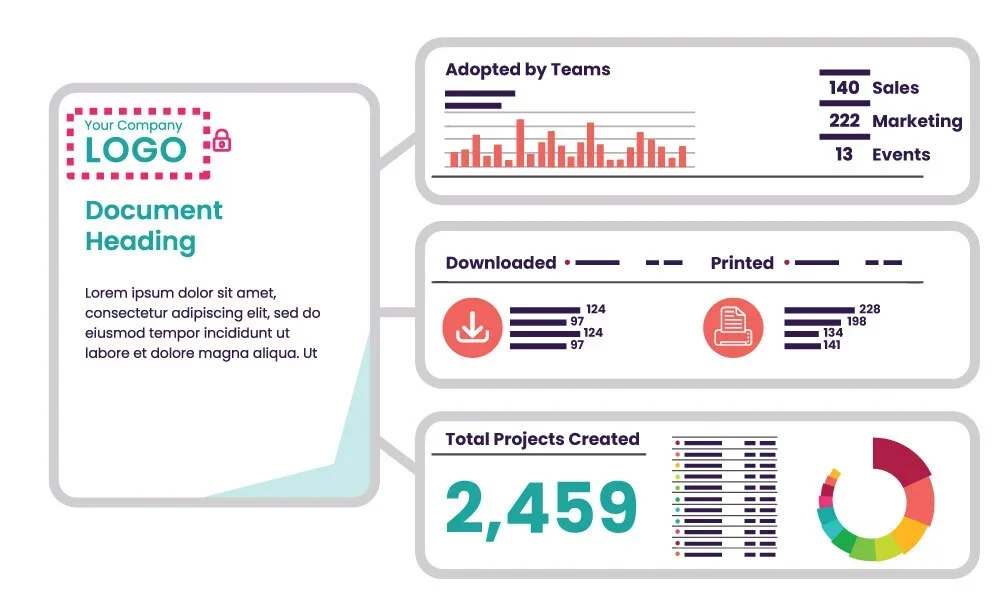
Marq’s analytics show which templates are used most, who is creating content, and which teams are still working from outdated assets. This data informs the brand team where the system is breaking down and where to focus governance efforts.
Metrics & KPIs that brand leaders should track
Brand metrics work best when they’re reviewed at the regional level on top of global levels. A high overall compliance rate can mask a single market with serious governance problems.
| KPI | What It Measures | Why It Matters Globally |
| Brand consistency score | Visual and messaging alignment across markets | Identifies markets drifting from global standards |
| Asset adoption rate | % of content built from approved templates | Signals whether governance is working or being bypassed |
| Campaign launch velocity | Time from approval to market-ready assets | Reveals localization bottlenecks by region |
| Translation turnaround | Days from English approval to localized versions | Tracks whether translation workflow is manual or automated |
| Compliance incidents | Brand/legal violations caught in review | Flags markets with highest governance risk |
| Template reuse rate | How often existing templates are used vs. new files created | Reduces version sprawl and off-brand creation |
Review by market, by team, and by asset type. Then, use the data to update template constraints, not just to report on them.
5 best practices for managing global branding
Each of the practices below for extending your global branding strategy connects back to a core principle: the system has to enforce the brand, not the people.
1. Separate brand standards from brand flexibility (in writing)
Every global brand team has an informal sense of what’s negotiable and what isn’t. Document it formally.
A written governance map that distinguishes globally locked elements from regionally adaptable ones gives regional teams a clear decision framework, and gives the central team a defensible basis for pushing back when a market goes off-script.
Marq’s template locking enforces this distinction technically while the governance map provides the rationale.
2. Build translation into the template workflow, not after it
The brands that get localization right build the translation step directly into the content production process.
That means templates designed with extractable text fields, connected to a professional translation provider (human or machine), with translated content flowing back into the same governed template.
The brands that struggle treat translation as a separate project and pay for it with weeks of delays and version sprawl.
Marq’s Crowdin, Lokalise, and Blend integrations make the connected approach possible without custom development.
→ Check out this demo of the translation workflow
3. Give regional teams the right amount of freedom
Over-locked templates frustrate regional teams and create workarounds. Under-locked templates produce brand drift. The right balance depends on the market and the brand element, and it requires intentional calibration, not a one-size-fits-all setting.
You can use Marq’s multi-level locking to set different constraints for different template elements: the logo is fully locked, the hero image is swappable from an approved library, the body copy is editable within character limits.
4. Treat compliance as a design requirement
For brands in regulated industries, legal review at the end of a campaign cycle is too late, especially when that campaign is shipping in eight markets with different disclosure requirements.
Build compliance into the template from the start.
Marq’s Smart Fields auto-populate the correct disclosures based on which market a template is opened in. The legal copy is correct before anyone makes a creative decision.
5. Audit the middle layer quarterly
Regional managers are the weakest link in most global brand systems because they’re closest to local business pressure and furthest from HQ visibility.
A quarterly audit of regional content (what was created, which templates were used, what didn’t pass review) keeps the middle layer accountable and gives the central brand team early warning before a market drifts too far.
Marq’s usage analytics make this audit faster as you can see template adoption and compliance rates by team in a single dashboard.
Systems that keep global brands consistent
The most effective global brand management systems combine a governed template platform (like Marq), a digital asset management tool for centralized asset storage and distribution, a translation management platform for localization workflows, and brand analytics to track compliance by market.
| Function | Tools | What It Does |
| Brand guidelines and governance | Bynder, Zeroheight | Single source of truth for brand standards; living reference for regional teams |
| Brand enablement and template governance | Marq | Encodes brand standards into governed templates; compliance at point of creation |
| Digital asset management | Bynder, Brandfolder, Canto | Centralized asset storage with rights management, expiration controls, and regional permissioning |
| Translation and localization management | Lokalise, Crowdin, Smartling | Professional translation workflows; connects content to translators without version sprawl |
| Brand compliance monitoring | Veeva Vault PromoMats, Compliant, Acrolinx | Automated review of content against brand and regulatory rules before/at point of publication |
| Analytics & brand tracking | Kantar BrandZ, Ipsos | Market-level brand health tracking across regions; ties brand investment to measurable outcomes |
Brand guidelines and governance: Bynder or Zeroheight
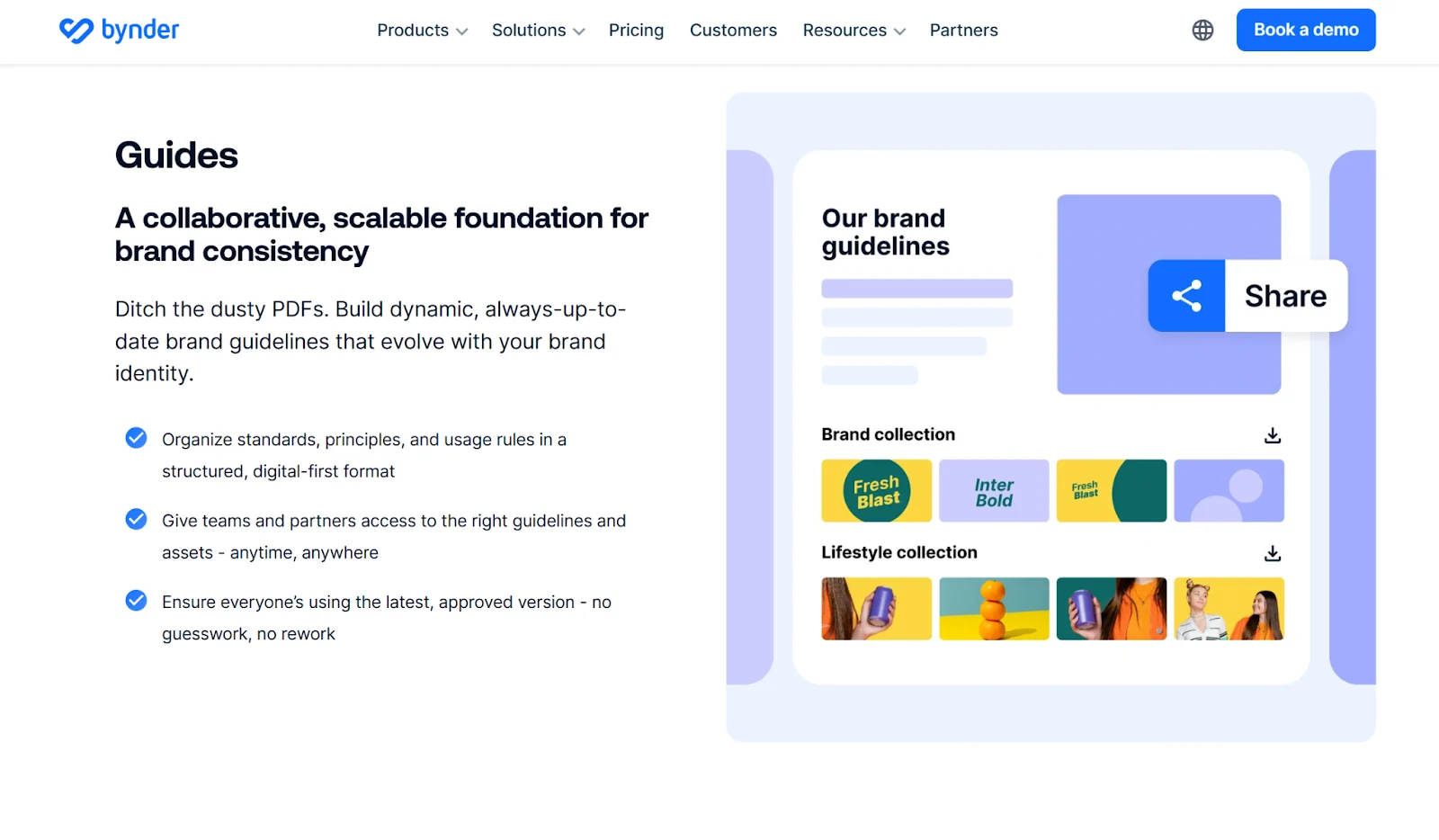
Every stack needs a single source of truth for brand standards. The key requirement: it needs to be a living reference, not a PDF that gets sent once and ignored.
This layer also needs to accommodate regional legal rules. A global brand guideline that doesn’t distinguish between what’s required in two different regions creates the exact problem it’s meant to solve.
The test is whether your regional teams can find the current version of the rule in under two minutes. If they can’t, the platform isn’t working.
Bynder and Zeroheight serve this function.
Marq integrates directly with Bynder, so your DAM assets flow into governed templates without teams ever needing to download, reupload, or hunt for the current version.
Brand enablement and template governance: Marq

Marq is a brand enablement platform built for distributed organizations that need to scale content creation without losing brand control.
The core capability is governed templates: designers build master templates in Marq (or import them from InDesign), lock the elements that can’t change, and make the rest accessible for regional teams to customize. The result is a self-serve content system that enforces brand standards automatically.
For global teams, Marq handles the complexity that breaks most template systems:
- Multi-brand support through separate brand kits, template libraries, and portals for each region, business unit, or sub-brand
- Smart Field with conditional logic so teams see the correct information for each market automatically
- Professional translations built into the workflow through Marq’s Lokalise integration
- Brand Guardian to flags assets that have drifted from approved standards before they publish
- CRM-connected creative automation and analytics that show which markets are staying on-brand and which need attention
For example, Engel & Völkers Gestalt Group scaled to 750+ advisors across 50 offices without adding to the central marketing team.
Digital asset management: Bynder, Brandfolder, or Canto

DAMs solve the “wrong file” problem for global teams, making sure every market pulls from the same approved library rather than a shared drive from three years ago.
Bynder and Brandfolder are the most mature options with:
- Metadata taxonomy that maps to regional market codes
- Rights and expiration management for licensed imagery
- User-level permissioning so regional teams can access but not modify master assets
Canto is also a strong option for mid-market organizations that need governance without the enterprise overhead.
Marq integrates directly with all three. Approved assets from your DAM flow into governed templates without teams downloading, reuploading, or hunting for the current version.
Translation and localization management: Lokalise, Crowdin, or Smartling
For brands operating across language markets, the translation workflow is where most global content operations slow down or break.
Lokalise, Crowdin, and Smartling all provide professional translation management, connecting your content to translators (human, machine, or hybrid) through a governed workflow. For global brand operations, they eliminate the email-based translation cycle that creates version sprawl and weeks of delay.
Lokalise and Crowdin both integrate directly with Marq: text fields extract from templates automatically, go to translators, and return into fully formatted, on-brand projects.
This means the translation step runs inside the same governed template environment rather than as a separate project with its own version control problem.
Brand compliance monitoring: Veeva Vault PromoMats, Compliant, or Acrolinx
Brand review at the end of a campaign cycle is often too late for regulated industries.
Compliance monitoring tools automate the review of live content against brand and regulatory rules before it ships, or flag it immediately after:
- Veeva Vault PromoMats is the standard for pharmaceutical and financial promotional content.
- Acrolinx turns brand governance from a human review gate into an automated quality layer that can run at any point in the workflow.
- Compliant offers custom rule sets that serve similar functions for organizations without the enterprise compliance overhead.
You can integrate automated compliance earlier in the workflow through these tools.
Analytics and brand tracking: Kantar BrandZ or Ipsos
The governance stack tells you whether the system is holding. Brand tracking tells you whether it’s working. For global teams, that means market-level data.
Kantar BrandZ and Ipsos provide market-level brand health tracking, showing leadership that brand investment in a specific market produced a measurable shift in recognition or trust. This is also the data that justifies the governance budget.
Marq’s usage analytics sit one layer below this, showing:
- Which templates are being used
- Which markets are creating content from scratch
- Where the compliance rate is dropping
Together, the two data sources give brand leaders a complete picture: what the system is producing, and how the market is receiving it.
Case study: scaling a global brand with centralized governance
Engel & Völkers, a European real estate brand, grew to 750+ advisors across 50 offices in 7 states.
The problem? The marketing system hadn’t kept pace.
Overview
- Several offices created marketing content inconsistently.
- There was no centralized system ensuring materials met brand standards.
- The volume of content demand was outpacing the capacity of the central marketing team to review and approve it.
Solution implemented
- Engel & Völkers Gestalt Group moved to Marq’s governed template system.
- Advisors could access a library of lockable templates: customizable enough to meet local needs, constrained enough to stay on-brand.
- The creative team maintained brand standards through template locks rather than manual review of every asset.
Results
- Marketing team members increased their output of assets, which grew brand awareness and brought in new business.
- More content was created more quickly company-wide without adding headcount.
- Advisors’ content requests were met faster, often within one day.
Key takeaways for brand leaders
Scaling a global brand is an exercise in increasing capacity, not just headcount. When the template does the enforcing, you break the dependency between output and hiring. Instead of adding more designers to manually review every asset, a governed system allows your existing team to produce more without becoming a bottleneck.
Scale across different GEOs without losing brand control with Marq
Global brand management at scale comes down to one question: can your system enforce the brand without the brand team in the room? If the answer is no, your brand system is functioning like a correction queue.
The frameworks in this guide give brand leaders the decision tools to build that system:
- A governance map that defines what’s fixed globally and what’s flexible by market, enforced through Marq’s multi-level template locking and multi-brand support
- Templates designed for localization from the start with translation built into the workflow through Marq’s AI Marqet integration with Lokalise and Crowdin
- Compliance encoded as a feature rather than a review step with Brand Guardian flagging drift
- Centralized asset access so the right file is always the easiest to find through Marq’s native asset management and direct DAM integrations
- Analytics that surface problems before they compound
Schedule a demo to see how global brand leaders are using Marq to scale without losing control.
FAQs:
- What is global branding?
Global branding is the process of maintaining a consistent brand identity (visuals, messaging, tone, and standards) across multiple countries, languages, and organizational structures.
- Why is global branding harder than domestic branding?
Domestic brand problems stay contained but global brand problems compound as language, regulation, cultural context, and organizational distance all interact simultaneously. The further the standard travels, the more it degrades.
- What’s the difference between brand translation and brand localization?
Translation swaps words but localization adapts meaning by adapting the imagery and content for local and cultural context. Brands that only translate end up with materials that are technically multilingual but contextually incorrect.
- My domestic template system works. Why is global rollout breaking it?
Domestic systems usually rely on two assumptions: a shared language and a centralized approval process. When you go global, these systems break under four new variables:
- Layout Adaptability: Designs may need to mirror for right-to-left (RTL) languages.
- Localized Compliance: Legal copy must change based on regional requirements.
- Cultural Nuance: Imagery and tone require regional adaptation.
- Operational Distance: Time zone gaps prevent HQ from catching mistakes before they ship.
To scale, your system must move beyond simple “locked” boxes, use features like Marq’s Smart Fields, translation integrations that automate these variables, and Brand Guardian for catching brand errors.
- What’s the difference between a global brand system and a global brand guideline?
A brand guideline is the rule and usually a PDF or portal documenting logo usage, colors, and tone. It relies on local teams to read, remember, and manually apply rules, often failing under deadline pressures or language barriers.
A brand system encodes your guidelines directly into the production environment, using locked elements and automated data (like Marq’s Smart Fields) to make sure the wrong font or logo can’t be used in the first place.
A guideline tells people what to do. A system makes it impossible for them to do it incorrectly.