AI content personalization: Benefits, best practices, and tools

- Personalization becomes harder to manage as organizations scale. More regions, partners, and regulated markets create more content variants, increasing the workload for creative teams and the risk of inconsistent output.
- Governance needs to be built into the personalization process. Approved templates, locked brand elements, structured data, controlled editing, and built-in approvals help teams create variants without compromising brand or compliance standards.
- Structured data makes personalization more reliable. Pulling information from sources such as CRMs, spreadsheets, or APIs reduces manual copy-paste work and helps ensure that each variant contains accurate, current information.
- Personalization needs measurable outcomes. Adoption, variant volume, compliance issues caught before publishing, and hours saved from the design queue show whether the system is actually reducing production effort while maintaining brand consistency.
AI content personalization uses AI to create tailored variations of a single piece of content at scale. For distributed teams, that can mean turning one approved asset into localized, co-branded, or personalized variations while keeping each version aligned with brand standards.
As companies expand across locations and markets, the need for these variations grows quickly. A single campaign may need dozens of versions with different locations, offers, contact details, or customer information. Creating and reviewing each version manually adds to the workload for central design teams, leaving less time for strategic work.
AI can help reduce that workload, but it plays only one part in the process. AI handles generative tasks such as drafting copy or adapting design templates. A chat interface lets users prompt those changes, automation brings the right data into each variation, and governance controls approved brand elements, permissions, and standards. These pieces work together to help distributed teams create more personalized content without losing control of the brand.
This article focuses on governed, on-brand content creation for distributed enterprise teams. It covers why personalization becomes harder to manage as teams scale, five best practices for using AI effectively, real-world examples and the ways to measure success.
Why the value of AI content personalization grows as teams scale
Personalization stays manageable until an organization adds locations, partners, and regulated markets. Then four pressures turn a routine task into a production bottleneck, and each one hands AI content personalization a specific job to do.
Variant volume outpaces manual production
One master and a hundred localized versions is the new normal. A brand team builds one brochure, then rebuilds it 40 times for 40 regions, changing a photo here and a phone number there. That work lands on a small creative team, and the math stops working.
Deloitte found that demand for marketing content grew 1.5x in a single year while teams met that demand only 55% of the time, so nearly half of every request shipped late or not at all. When the backlog grows, sales and field teams stop waiting and make their own versions, and brand consistency slips the moment they do.
Distribution networks demand co-branded personalization
Advisors, loan officers, and dealers each want collateral that carries their own name next to the parent brand. A loan officer needs a rate sheet with their photo, contact block, and license number by tomorrow.
When the central team cannot produce that fast enough, the field rebuilds it in a consumer design app, and the logo drifts into three slightly different blues across the network.
A Marketing lead at a US regional bank shared with us, “We get requests from our loan officers, and primarily we do those in Canva. As we scale, we double in size for loan officers, and we need to be able to have loan officers with their own access.”
Regulatory and legal variance requires per-variant accuracy
State-specific disclaimers, product language, and partner license numbers can change from one version to the next. In financial services and insurance, marketers often copy and paste disclaimers across hundreds of flyers. One incorrect line can make it onto a live asset and trigger a compliance review that pulls the entire campaign back.
Higher education teams face a similar challenge across departments and campuses. A single approved fact sheet may need to appear in dozens of localized versions, each with the correct information for its audience.
Brand integrity is the ceiling on personalization
Every new variant creates another opportunity for brand inconsistency, so governance determines how far personalization can scale safely. Give teams an unrestricted canvas and one rep may use an outdated logo, another may change a required disclaimer, and a third may select an unapproved font.
Each mistake can reach a customer-facing asset, creating inconsistent brand experiences across regions. Adding more detailed guidelines does not solve the problem when teams already struggle to follow them under deadline pressure.
The solution is to build controls into the assets themselves: lock elements that cannot change, expose only the fields users need to edit, and check each version before it ships. Personalization can scale when governance stays with every asset throughout the creation process.
Explore AI tools for brand management that can help protect brand standards as content creation scales.
5 best practices for implementing AI content personalization
Personalization succeeds or fails on how you set it up. The five practices below move the work from ad hoc file edits to a governed system.
| Best Practice | What It Does | Why It Matters |
| Start with the master, not the AI | Locks the source template so only approved fields change | Off-brand output starts at the source, not the model |
| Ground personalization in structured data | Populates variants from CSV, CRM, or API | Removes manual copy-paste and the errors it introduces |
| Bake approval into the workflow | Routes every variant through the same review as manual work | Compliance teams will not adopt a workflow that skips them |
| Give the field a controlled edit surface | Lets reps change specific fields, nothing else | Distributed teams personalize without going rogue |
| Instrument from day one | Tracks usage, volume, and off-brand catches | Gives you the data to defend the platform upstairs |
1. Start with the master, not the AI
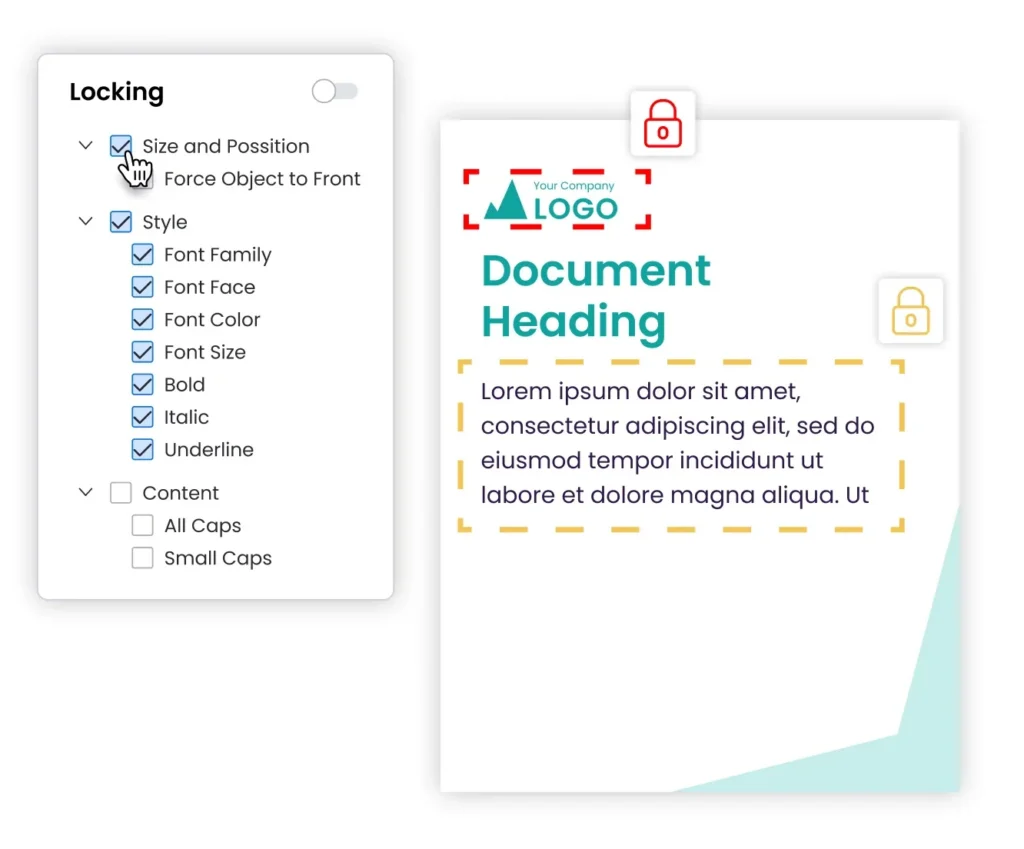
AI content personalization only works when the source template is built for variation. Design the master first, decide what should never change, and lock it. Colors, logo placement, and legal footer stay fixed. Contact block, headline, image, and disclaimer stay open.
A designer builds this once, then converts it into a governed template that non-designers can fill safely. From there, a regional team produces their version without touching a single protected element, and the brand holds no matter who is editing.
Marq builds that control into the template itself: you set locking at whatever level you need, from a full project or page down to a single image or text block, and apply full or partial locks that fix an element’s size, position, or style while leaving the rest open to edit.
2. Ground personalization in structured data, not free-form prompts
Rate sheets, benefits guides, and location fact sheets should populate from a spreadsheet, a CRM record, or an API call, not from a model writing them from scratch.
A real estate team uploads an MLS export and receives hundreds of listing flyers, each with the right address, price, and agent, in minutes rather than days.
Keep it deterministic wherever accuracy matters, and reserve generative fill for the places where a marketer has authorized creative variance, such as a headline or a supporting image. That split is the difference between output you can trust and output you have to proofread line by line.
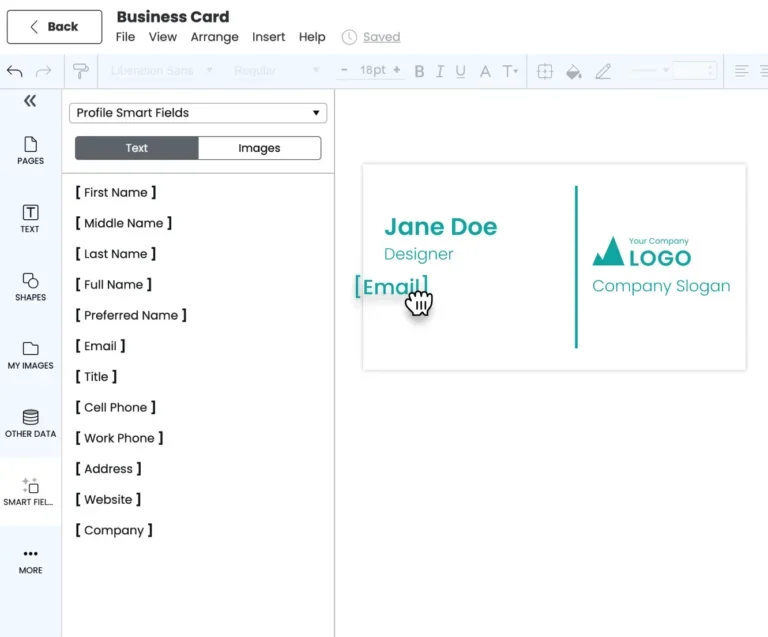
Marq’s Smart Fields handle the deterministic half. Structured data and automation fill the exact fields that have to be right every time, such as price, address, and agent information, while AI adapts the creative fields a marketer has opened up, such as approved copy or imagery. Keeping those two jobs separate is what makes personalization at scale both fast and trustworthy.
3. Bake compliance and approval into the workflow, not after it
Personalized variants should route through the same approval chain as anything a designer produces manually. Build the review step into the workflow so a content piece cannot publish until the right person clears it.
In insurance and financial services, high-risk external content often needs compliance approval before it goes live. The level of review depends on the organization and the risk associated with the content.
Internal materials may need a lighter review, while customer-facing collateral with disclaimers, license numbers, or regulated claims may require a full compliance check. When approval happens within the system, teams also get a clear audit trail that shows what changed in each version and who approved it before publication.
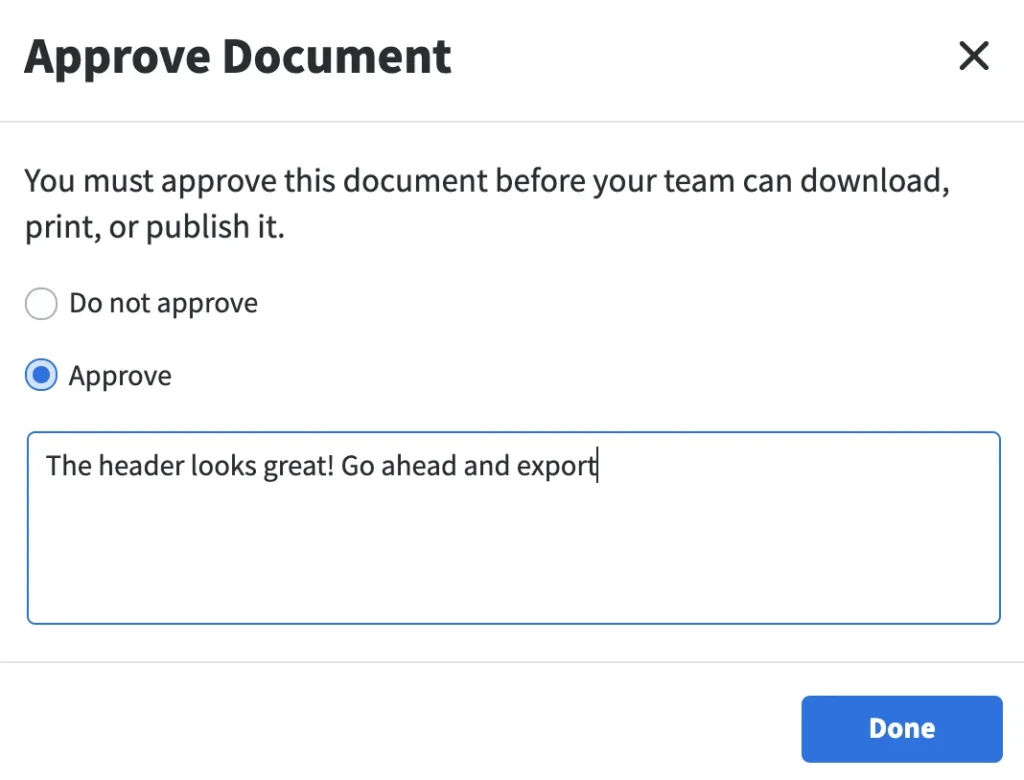
Marq handles this with approval rules set at the account or user level, plus a project approval step that blocks anyone from exporting, printing, or publishing until a reviewer signs off.
4. Give the field a controlled edit surface, not an open canvas
Advisors, loan officers, dealers, and clinic managers should personalize inside guardrails. Let them swap a logo, edit a contact block, and insert a state disclaimer, and stop them there. An open canvas invites well-meaning people to move the logo, change the font, and break the layout while racing a deadline.
A controlled edit surface gives the field exactly the flexibility they need and none of the freedom that creates cleanup work later. Role-based access defines who can edit, localize, and publish, so central teams set the boundaries once and the field works inside them.
5. Instrument for adoption and errors from day one
Track template usage, personalization volume, off-brand incidents caught before publishing, and hours reclaimed from the design queue. This data does two things: it shows whether the field actually adopted the system or quietly went back to old habits, and it gives you the numbers to defend the platform to a CFO who wants to know what it returned.
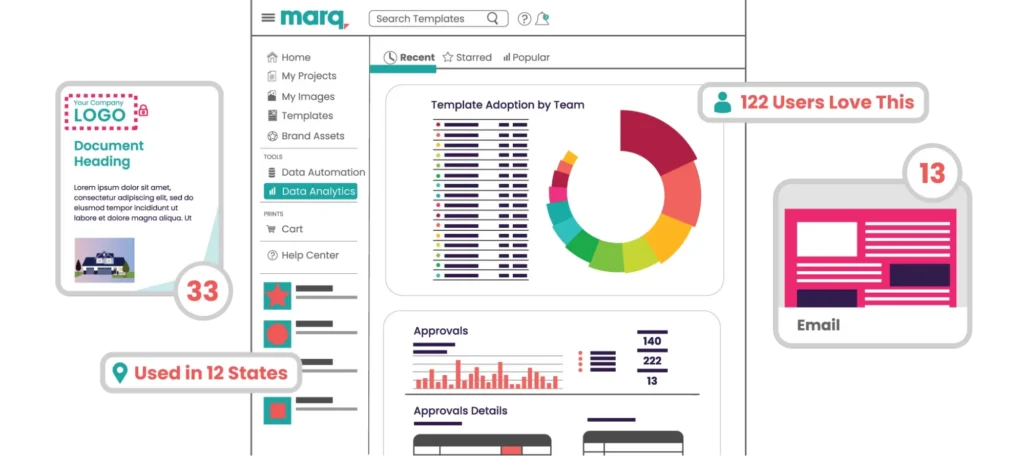
The stakes are clear in the data. 81% of content marketing teams now use AI, yet only 19% track AI-specific KPIs, so the teams that measure are the ones who can prove what the investment did. Marq’s template analytics report adoption and usage across teams, which turns that measurement gap into something you can act on.
How organizations can scale content personalization with automation and AI
This pattern repeats across creative and marketing teams from regulated, distributed industries: one central team, many locations or representatives, and more personalized content than manual production can support.
The examples below show how three organizations built a scalable foundation with templates, data automation, and controlled customization. Each example also highlights how a team in a similar situation could add AI to accelerate production while keeping accurate information and brand standards in place.
Financial services: Automating branch rate sheets from one source
One marketing team supported 24 branches and lost time rebuilding rate sheets and branch flyers from scratch every time rates changed. Connecting one source file to branded templates through automated smart fields now lets the team update rates once, and each branch a pre-populated localized version to auto-populate as needed. Now branch marketers can produce their own localized versions without central rework.
“Any time the rate changed, I had to go into the doc and manually update every single field. It was not fun,” says an AVP, communications and marketing, US regional bank.
How AI could extend the workflow: A team in a similar situation could use AI to generate finished, branch-specific rate sheets and flyers in bulk, without asking local marketers to open and refresh each template. The Bulk Create app in AI Marqet applies the approved rate and branch data across every version and delivers on-brand, ready-to-use materials.
Healthcare: Supporting more than 500 clinics with local content
A marketing team supported more than 500 clinics across 26 states. Creating personalized branded resources at the volume each location needed was unsustainable.
One master template with brand-locked fields now allows each clinic to create accurate, on-brand resources without waiting for the central team to rebuild them.
“We have 500+ clinics across 26 states. We’ve struggled to get them the resources they need hyperlocally in a way that is scalable for our team,” says a Senior Marketing Manager, multi-state healthcare provider.
How AI could extend the workflow: A similar network could run localized assets through an AI-assisted brand check before distribution. Brand Guardian flags potential issues with colors, typography, logos, and other configured brand standards.
See how Marq supports healthcare marketing teams.
Insurance: personalizing complaint collateral for 2,000 sales executives
A large carrier needed tailored materials for 2,000 sales executives across multiple subsidiaries and sub-brands. Governed templates and connecting location, contact, and other key data to set text fields allows the team to personalize collateral without losing oversight of each brand.
“It was difficult to personalize marketing materials for 2,000 sales executives. With so many subsidiaries who had their own sub-brands, there were questions about how to keep an eye on our branding and make sure everything was compliant,” says a Product Marketing Manager, US insurance enterprise.
How AI could extend the workflow: When approved plan details change, a carrier could automatically update and distribute affected pieces of sales collateral with minimal brand template bases, eliminating thousands of manual rebuilds. During open enrollment, for example, new rates, benefits, and coverage details could flow into the correct materials for each representative and sub-brand. In Marqet, Playbooks automate this scheduled content generation and delivery.
How to track success
Personalization is easy to launch and hard to prove. Set your metrics before you scale, then watch them from the first week:
- Adoption: Measure how many templates the field uses and how many people log in to produce their own variants. Low adoption usually means the field went back to a consumer design app, and you want to catch that early.
- Personalization volume: Count the variants produced per template and per region. Rising volume against flat central headcount is the clearest sign the system is doing the work instead of your team.
- Off-brand incidents caught before publishing: Track how often approval stops a non-compliant variant. This is the number that shows governance working, and the one compliance and legal care about most.
- Hours reclaimed from the design queue: Compare production time before and after. This converts directly into the return figure a finance team will ask for.
Tie these back to revenue where you can. Because consistent brand presentation can lift revenue by up to 33%, off-brand catches and reclaimed hours are not just operational wins, they protect the consistency that drives the number.
Automate marketing operations with AI speed and control
AI now lets producers and customer-facing teams create content variants faster than any manual process can govern. Personalization is table stakes, so the question is no longer whether you can generate variants at scale.
It is whether you have a brand system that can govern them once you do. Lock your core brand elements, populate from trusted data, route everything through approval, and measure what gets posted. To see how Marq handles governed personalization for your team, book a demo.
FAQs
What is AI content personalization?
AI content personalization is the use of AI to produce tailored versions of the same content at scale. In the enterprise, it usually means generating localized, co-branded, or data-populated variants of one approved template, then confirming each is on-brand and compliant before publishing.
How is AI content personalization different from marketing personalization?
Marketing personalization targets individual customers with tailored messages and offers, usually driven by behavioral data. AI content personalization produces the on-brand assets themselves at scale, so many teams run both: one decides what each customer sees, the other creates the compliant creative that appears.
Can AI content personalization work in regulated industries?
Yes. As AI improves, teams may come to trust it with more autonomy. But for now, keeping approval inside the workflow matters just as much for AI-generated content as for manual work, if not more.
Do I need a DAM to use AI content personalization?
No, though digital asset management helps when you already store approved assets in one. Marq connects to your DAM and activates those assets inside templates, so reps and partners personalize with approved logos and images instead of hunting for the right file. See DAM integrations for templating.
How do I keep AI-generated content on-brand?
Lock the master template, open up only the fields that should change, and route every variant through approval before it publishes. Governance built into the workflow, rather than checked afterward, is what keeps personalization on-brand as volume climbs.